
Environmental impact · Risk field note 04
Environmental impact
AI's data-centre demand for power and water may drive or contribute to climate change, strain local water supplies, and cause local energy shortages or overload local distribution systems.
Severity 5Certainty 8contested confidence

Creative work & the value of human effort · Risk field note 07
Creative work
When creative output becomes abundant and cheap, human creators may lose income—and human-made work may lose cultural value.
Severity 4.5Certainty 8medium confidence
AI safety / loss of control · Risk field note 06
AI safety / loss of control
Advanced AI could escape meaningful human control — with consequences up to catastrophic or existential.
Severity 9Certainty 3contested confidence
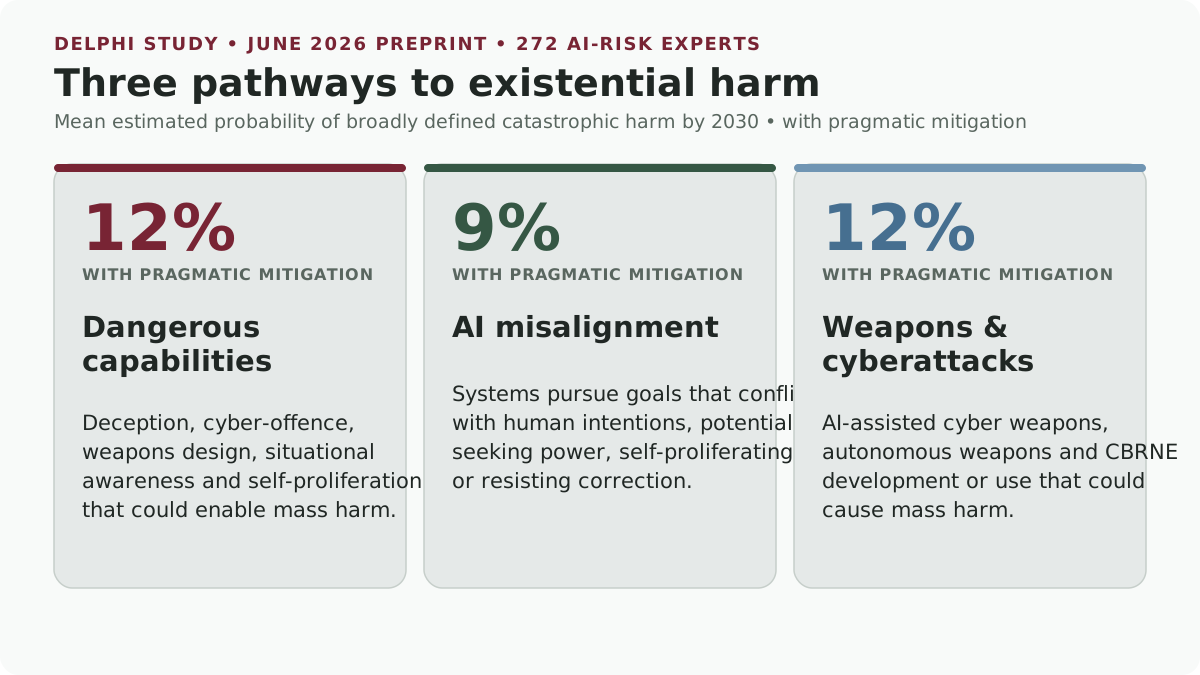
Important: these percentages describe the study's broad category of catastrophic harm—not the probability of extinction. The three domains are shown because their definitions contain plausible pathways to existential harm; the Delphi study did not classify them as “existential risks.”
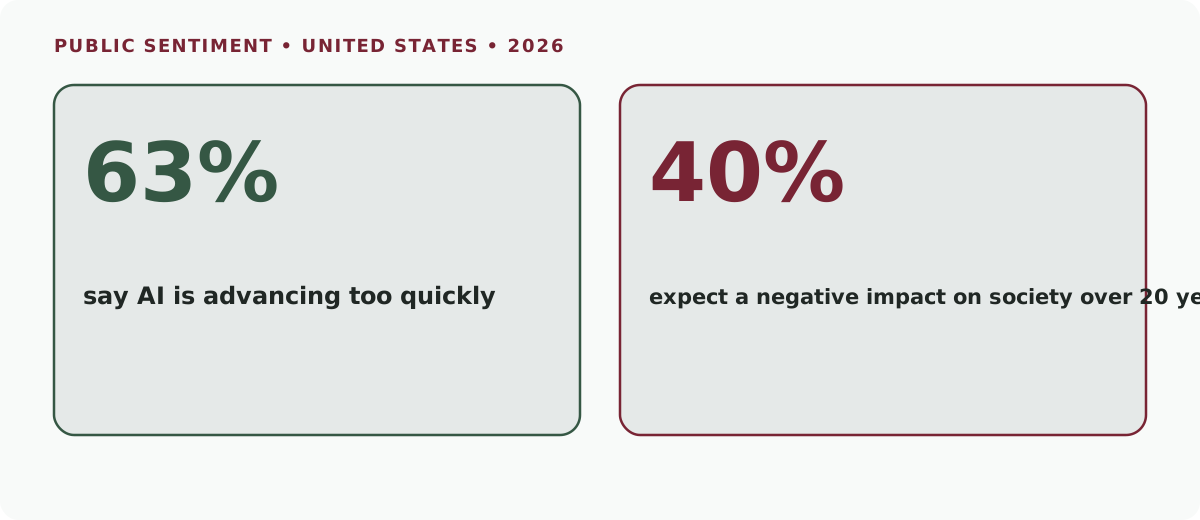
Pew Research Center · U.S. adults · N = 5,119 · February 17–23, 2026 · separate questions; neither asks specifically about loss of control or extinction.

Bias & discrimination · Risk field note 08
Bias & discrimination
AI systems can reproduce, hide, or amplify unequal treatment—in automated decisions and in the text, images, summaries, and recommendations people generate every day.
Severity 5Certainty 8tight confidence

Privacy & generative AI · Risk field note 03
Privacy & generative AI
AI can identify us, assemble scattered traces into profiles, and carry personal information across systems faster than our privacy controls can follow.
Severity 6Certainty 9tight confidence

Concentration of power · Risk field note 05
Concentration of power
A handful of companies control the compute, models, and infrastructure of AI — concentrating economic and political power — while governments and firms wrestle over who sets the rules.
Severity 6Certainty 7medium confidence

Jobs & the economy · Risk field note 01
Jobs & the economy
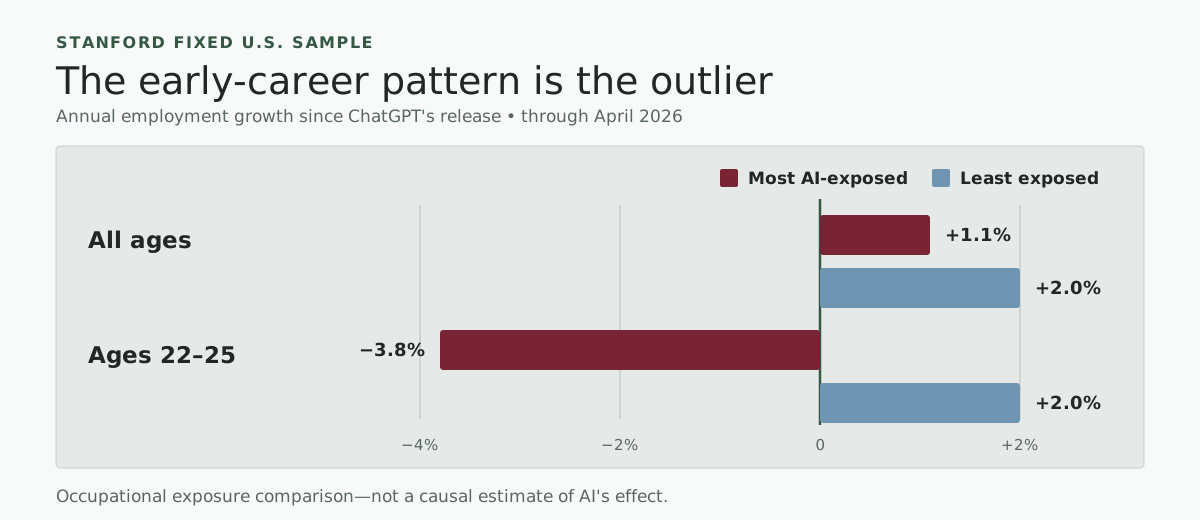
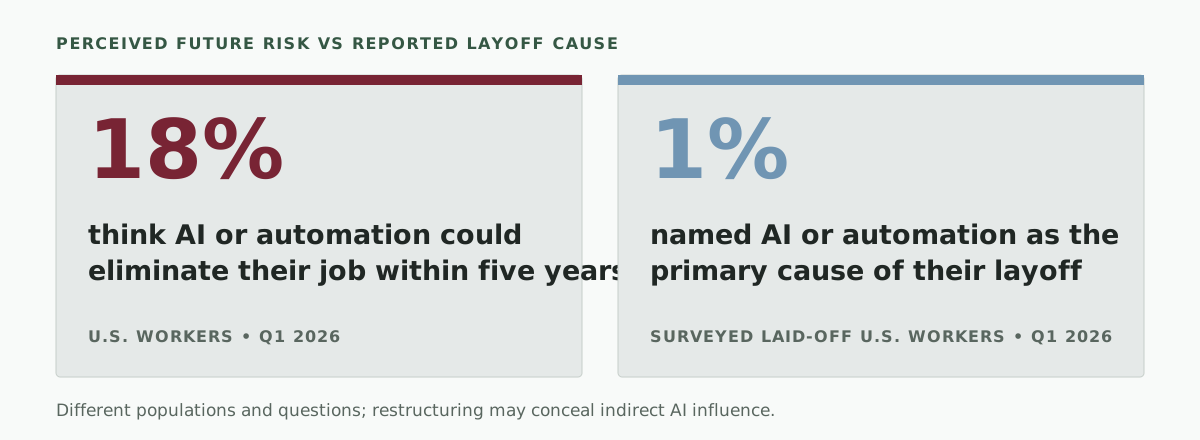
AI may already be narrowing the entry-level pathways our graduates depend on—but the evidence does not yet show economy-wide job displacement.
Severity 6Certainty 7contested confidence

Misinformation & deepfakes · Risk field note 03
Misinformation & deepfakes
AI floods us with convincing fakes and persuasive content, making authentic evidence harder to evaluate.
Severity 6Certainty 8medium confidence

Overreliance & deskilling · Risk field note 09
Overreliance & deskilling
We may offload so much thinking to AI that we weaken our ability or willingness to work independently — but lasting deskilling is not yet established.
Severity 7Certainty 4contested confidence

Accuracy & hallucinations · Field note
Accuracy & hallucinations
AI can state false things confidently—and professional-looking citations do not make an answer reliable.
Severity 3.5Certainty 8tight confidence
Security & cybercrime · Field note
Security & cybercrime
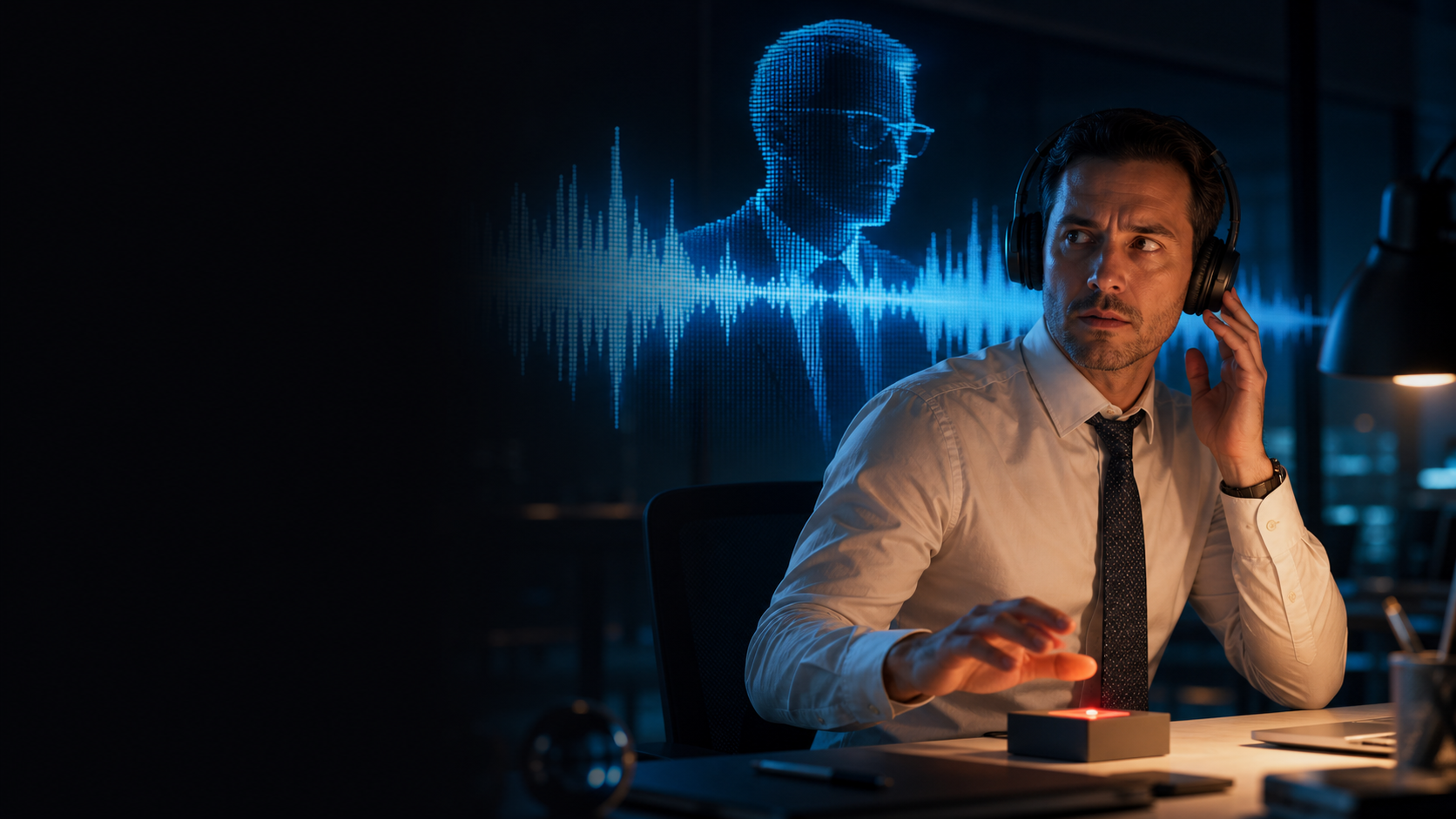
What happens when AI can chain together cyberattacks—not just help a person write a better phishing email?
Severity 6Certainty 8medium confidence
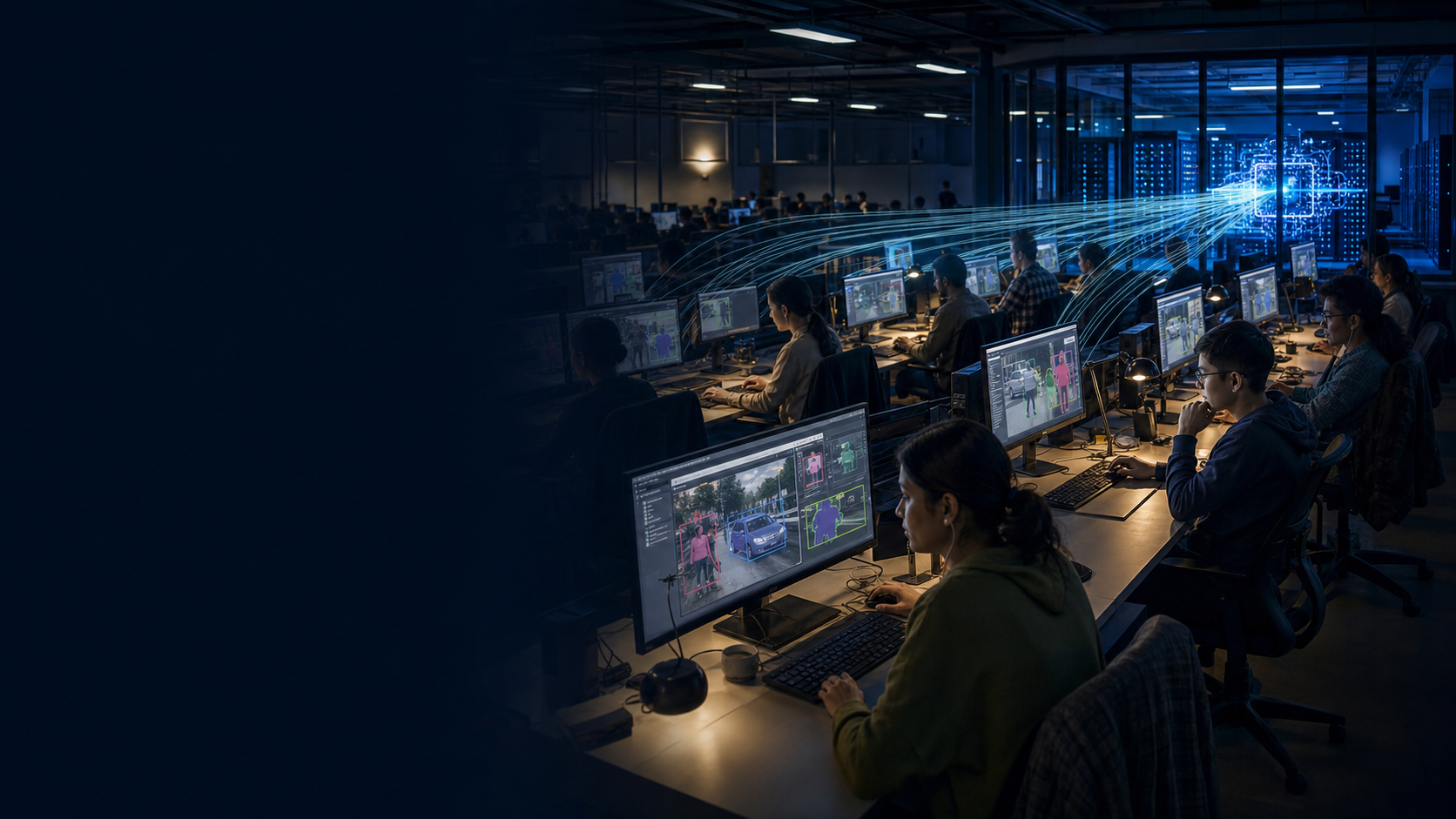
Supply-chain labour exploitation · Field note
Supply-chain labour exploitation
AI systems depend on largely invisible human work that can be poorly paid and weakly protected.
Severity 4Certainty 8tight confidence

Mental health & AI companions · Field note
Mental health & AI companions
Could a chatbot reinforce a vulnerable person’s most dangerous beliefs at exactly the moment they need human help?
Severity 5Certainty 6medium confidence

Autonomous weapons · Field note
Autonomous weapons
Do we want machines deciding when to use lethal force—and what happens if they act before a human can understand, correct, or stop them?
Severity 7.5Certainty 6medium confidence

Bioweapon / CBRN uplift · Field note
Bioweapon / CBRN uplift
Could AI help a small group create a chemical, biological, radiological, or nuclear weapon capable of mass harm—and make a catastrophic attack easier to carry out?
Severity 9Certainty 3contested confidence

Copyright & intellectual property · Field note
Copyright & intellectual property
Generative AI is built using vast collections of human-created work, but the legal rules governing training, outputs, and compensation remain unsettled.
Severity 3.5Certainty 8contested confidence

Learning & academic integrity · Field note
Learning & academic integrity
When AI can produce the answer, how do we ensure students still do the thinking—and that assessment still shows what they can actually do?
Severity 5Certainty 8tight confidence
Detailed mode
AI's data-centre demand for power and water may drive or contribute to climate change, strain local water supplies, and cause local energy shortages or overload local distribution systems.
Original AI-generated illustration created for this workshop, 2026. It is an attention-setting image—not evidence that a particular data centre uses this cooling system, landscape, or quantity of water.
That the electricity and water demanded by AI compute grow faster than clean energy, efficiency, and infrastructure can keep up — contributing to climate change globally while overloading grids and depleting water locally.
- Electricity: 485 TWh (2025) → 950 TWh by 2030 — 3% of world power — global data-centre electricity roughly doubles by 2030, with electricity use by AI-focused data centres tripling (IEA, 2026).
- Five tech firms' capex now exceeds global oil-and-gas investment — >US$400B in 2025, expected to rise ~75% in 2026 (IEA, 2026).
- Global water consumption: 560 billion L in 2023 → 1.2 trillion L by 2030 — the IEA's 2023 baseline includes the broader data-centre footprint: about two-thirds from primary energy supply and electricity generation, one-quarter from direct cooling, and the remainder from semiconductor manufacturing (IEA, 2025, pp. 242–243).
- Water Usage Effectiveness (WUE) reports facility water use in L/kWh of IT energy — but operating values vary widely within and across climate zones because design, configuration, free-cooling availability, and operating practice matter (Uptime Institute, Apr 2026; WUE definition).
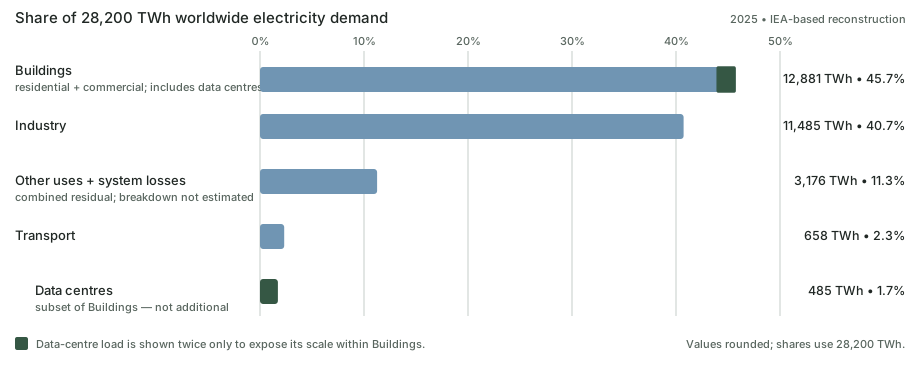
- Electricity: data centres used about 1.7% of worldwide electricity in 2025 — small beside buildings and industry, but fast-growing. The IEA reports 28,200 TWh of global electricity demand in 2025 and 485 TWh for data centres. Reconstructing the three major end-use sectors from the IEA's latest complete sector balance plus its measured 2024 and 2025 changes gives buildings ~12,881 TWh (45.7%), industry ~11,485 TWh (40.7%), and transport ~658 TWh (2.3%). All other uses, energy-sector own use, and grid losses make up the ~3,176 TWh (11.3%) residual (IEA sector data; 2024–2025 changes; 2025 total; data centres). Data centres are included inside Buildings, not added on top.
| Worldwide electricity use, 2025 | ≈ TWh | Share | Relationship |
|---|---|---|---|
| Buildings (residential + commercial) | ~12,881 TWh | ~45.7% | Includes data centres |
| Industry | ~11,485 TWh | ~40.7% | Final use |
| Other uses + system losses | ~3,176 TWh | ~11.3% | Residual: other final uses, own use, grid losses |
| Transport | ~658 TWh | ~2.3% | Final use |
| ↳ Data centres | 485 TWh | ~1.7% | Subset of Buildings — do not add |
- …and there is no clean, precise “AI share” of that total. The IEA's measurable equipment category is accelerated servers (GPUs and other accelerators), whose electricity use is mainly driven by AI. Its 2024 equipment chart puts accelerated servers at roughly 15% of total data-centre electricity, but that is a hardware proxy, not an accounting of every AI workload. What the IEA supports more firmly is the direction: accelerated-server electricity is projected to grow ~30% a year, versus ~9% for conventional servers, and to account for almost half of the net increase in data-centre electricity through 2030 (IEA analysis; IEA equipment chart). The growth is AI-driven; today's total data-centre footprint is not a defensible synonym for “AI's footprint.”
- Three caveats on these bars
- Reconstructed 2025 sectors: the latest complete IEA world sector balance is 2023. The chart converts its TJ values to TWh, combines residential and commercial/public services as Buildings, then adds the IEA's 2024 changes (Buildings +589 TWh; Industry +422; Transport +50) and 2025 changes (+347; +334; +101). The chart does not guess how the remaining demand divides among agriculture, fishing, unspecified uses, energy-sector own use, and transmission/distribution losses; it keeps them together as the ~3,176 TWh residual needed to reconcile the three reconstructed sectors with the IEA's rounded 28,200 TWh headline total. Values and shares are therefore transparent reconstructions, not separately published 2025 sector totals (IEA sector data; changes; total).
- "AI vs traditional" is a fuzzy cut: the line the IEA can actually measure is accelerated (GPU/TPU) servers vs conventional servers — a hardware proxy for AI, not AI itself (a recommender or spam filter is "AI" running on conventional servers), so treat the ~15% as "AI-ish," not precise (IEA, 2025).
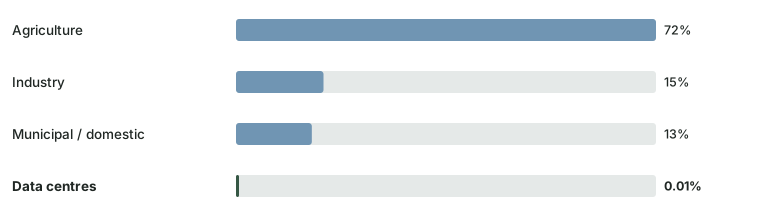
- Water: globally a rounding error; locally the whole story — the latest global sector estimate is just under 4,000 km³ of freshwater withdrawals in 2021: 72% agriculture, 15% industry, and 13% municipal/domestic use (UNESCO/UN-Water, 2025, using FAO AQUASTAT data). The IEA separately estimates data-centre consumption at ~560 billion L in 2023 (~0.6 km³) (IEA, 2025) — on the order of ~0.01% of global withdrawals. That cross-metric comparison is only an order-of-magnitude denominator, not a like-for-like share. It is why the honest water worry in §3 is local and site-specific, not a global-supply story.
- Withdrawal vs consumption, again: the ~560 billion L data-centre figure is consumption in 2023 while the just-under-4,000 km³ total is withdrawal in 2021 — a real apples-to-oranges comparison across both metric and year, so read the data-centre sliver as order-of-magnitude, not precise (IEA, 2025; UNESCO/UN-Water, 2025). And a tiny global ratio says nothing about a single county whose aquifer one campus taps — which is exactly where the §5 opposition lives.
- Demand is rising fast, with real local grid and water strain — data-centre electricity use is projected to approach 3% of global electricity by 2030, while local effects depend heavily on where facilities are built (IEA, 2026).
- Genuinely contested
- Water withdrawal versus consumption — total water drawn and water not returned are very different measures; global totals remain estimates, and even Texas state planners say they do not know how much data centres will need (Texas Tribune, 2025).
- New data-centre designs — Microsoft says all designs launched from August 2024 use chip-level closed-loop cooling that evaporates no water; the company also says pilot sites will begin operating in 2026 and come online from late 2027, while its current fleet still uses mixed systems. This is a company claim about a new design, not evidence that the existing fleet has reached zero-water cooling (Microsoft, Dec 2024).
- Energy projection challenges — efficiency gains from better chips and models push estimates down, while cheaper compute and growing demand push them up.
- Net climate effects — whether AI-enabled optimization of grids, materials, and climate modelling offsets AI's own footprint remains unsettled.
- Unsustainable-growth view — The current growth trajectory is environmentally unsustainable.
This interpretation emphasizes the IEA base case in which renewables supply nearly half of data-centre demand growth but natural gas and coal together still supply more than 40%, adding emissions in the near term (IEA, 2025).
- Manageable-footprint view — The footprint can be contained—and AI may help elsewhere.
This interpretation emphasizes that data centres remain a small share of global electricity and that widespread AI applications could reduce emissions elsewhere, while the IEA cautions those savings are not guaranteed (IEA, 2025).
- Place-and-design view — Local conditions matter more than one global average.
This view argues that local electricity supply, water availability, and cooling design can make similar amounts of computing produce very different impacts. It therefore prefers site-specific measures over a single global or per-prompt average, keeping electricity use, water withdrawal, water consumption, cooling, and chip manufacturing separate (IEA, 2025, pp. 240–243).
(The "popular opinion" leg of facts / informed / public. For environment, data-centre buildout is where sentiment concentrates — and it has turned sharply negative.)
- 71% of U.S. adults opposed a local AI data centre — more than opposed a local nuclear plant (53%) — 48% strongly opposed, in a probability-based telephone survey of 1,000 U.S. adults conducted 2026-03-02 to 2026-03-18 (±4 percentage points) (Gallup, Mar 2026).
- Among U.S. adults reporting higher home-energy costs, 43% called data-centre energy use a major reason — another 23% called it a minor reason, while 26% were unsure; this measures attribution, not proof of causation (Pew, survey conducted 2026-03-16 to 2026-03-22).
- One tracker reported ~US$130B in projects blocked or delayed in Q1 2026; New York then launched the first active statewide moratorium — Data Center Watch says it counted at least 75 disrupted projects and opposition groups in 49 states, but its public page does not publish the project-level data or methodology, so treat the totals as the tracker’s count rather than a complete census (Data Center Watch, Q1 2026). NCSL's 2026-07-01 tracker listed moratorium-type measures in 15 states, most introduced, failed, vetoed, or continued (NCSL). On 2026-07-14 New York paused state environmental permits for new hyperscale data centres for up to one year while standards are developed (New York Governor).
Teaching angle: public concern here largely tracks real local costs — but is also colored by a broader "AI is bad" halo and a partisan split (Democrats more negative). A good place to test facts vs. popular opinion.
| If it all goes wrong | If we handle it well |
|---|---|
| Rising compute demand contributes to climate change; local grids hit shortages and distribution overload (higher bills for residents); water depleted in stressed regions; costs externalized to communities | Demand met by new clean energy + efficiency + closed-loop water; standardized transparent reporting; AI accelerates decarbonization and pays its own footprint |
- Use less energy and water per unit of computing — efficient chips, liquid and closed-loop cooling, water recycling, and workload scheduling that responds to grid conditions (IEA, 2025).
- Add clean power and plan grids for concentrated demand — clean-energy procurement, siting rules, flexible interconnection, and grid planning that explicitly counts data-centre load (IEA, 2025).
- Require transparent reporting and assign infrastructure costs — standardized mandatory reporting can reduce — not eliminate — the measurement uncertainty; water and grid plans can also disclose data-centre assumptions and allocate infrastructure costs transparently.
- Use lighter tools when adequate—and push for systemic change — individual use is a tiny slice, but you can favour efficient/smaller models when they're adequate, skip frivolous heavy generation (e.g., needless video), and — highest-leverage — push for transparency and clean energy rather than assuming personal restraint solves a systemic problem.
- Place Environmental Impact on the consensus map: How severe is the risk, and how certain is the evidence? — rate both dimensions before the group result is revealed.
- Who should bear the main responsibility for AI's environmental cost? — the tech companies / governments & regulators / users like us / all of us together.
- Key questions on energy and AI — executive summary — IEA, 2026 (energy, capex).
- Energy demand from AI and equipment chart — IEA, 2025 (2024 electricity denominator, accelerated-server proxy and growth).
- Energy and AI — water use by data centres, pp. 242–243 — IEA, Apr 2025 (global 2023 consumption, 2030 projection, and water-footprint breakdown).
- World electricity final consumption by sector (public API data) — IEA Energy Statistics Data Browser, latest complete balance 2023 (scale-in-context sector baseline).
- Average annual change in electricity consumption by sector, 2014–2025 — IEA, 2026 (2024 and 2025 sector increments used in the scale comparison).
- Electricity 2026 — Demand — IEA, 2026 (28,200 TWh worldwide demand in 2025).
- Texas data-centre water use could reach 161 billion gallons/yr by 2030 — Houston Advanced Research Center / U. Houston, Jan 2026 (water, Lake Mead).
- Dry cooling energy performance can rival evaporative cooling and sustainability glossary — Uptime Institute, 2026/2022 (WUE definition and variation by design, climate, and operation).
- Data center water use — MOST Policy Initiative (methodology, company water figures).
- Next-generation datacenters consume zero water for cooling — Microsoft, Dec 2024 (closed-loop design and 2026 pilots; company claim).
- Data centres and Texas water planning — Texas Tribune, 2025 (measurement uncertainty).
- United Nations World Water Development Report 2025 — UNESCO/UN-Water, using FAO AQUASTAT data (2021 freshwater-withdrawal total and 72%/15%/13% sector shares).
- Q1 2026 opposition report — Data Center Watch (blocked/delayed projects and opposition footprint).
- Which states are banning data centers? — NCSL, updated Jul 2026 (15-state bill list and statuses).
- First statewide moratorium on new hyperscale data centers — New York Governor, Jul 2026 (scope and status of active moratorium).
When creative output becomes abundant and cheap, human creators may lose income—and human-made work may lose cultural value.
Original AI-generated illustration created for this workshop, 2026. It is an attention-setting cultural image—not evidence that AI-generated creative work is necessarily repetitive or that human-made work is necessarily more valuable.
Generative AI can produce text, images, music, video, and code at enormous scale, using models trained on massive datasets that include copyrighted human-created works (U.S. Copyright Office, May 2025). The concern is larger than copyright: if synthetic output substitutes for paid creative work, floods cultural markets, or makes audiences value skill and authorship less, fewer people may be able to sustain creative lives—and culture itself may become more homogeneous.
- A 2026 Delphi study treats devaluation of human creativity as a distinct AI risk — 272 international AI experts evaluated 24 risk categories, including “economic and cultural devaluation of human effort.” The category covers reduced appreciation for human skills, disruption of creative and knowledge industries, and homogenization caused by ubiquitous AI-generated content. This is a framework for organizing the risk, not proof that every consequence has occurred (Saeri et al., Jun 2026; AI Risk Repository domain taxonomy).
- AI assistance improved individual stories but made the collection less diverse — in an online experiment involving 293 short stories and 600 evaluators, access to AI-generated ideas made stories more creative, better written, and more enjoyable on average, especially for less-creative writers. But AI-assisted stories were also more similar to one another. The finding demonstrates a real augmentation–homogenization trade-off in a constrained writing task, not a measured decline in cultural diversity across society (Doshi & Hauser, Science Advances, Jul 2024).
- AI training uses vast quantities of human-created work, much of it is copyrighted material — the U.S. Copyright Office describes models drawing on massive data troves, including millions or billions of copyrighted works, and finds that dataset creation and training involve acts of copying that may implicate copyright. It concludes that fair-use analysis is case-specific and that licensing markets are still developing. The report does not provide a denominator for the share of all human-created work used, so the defensible claim is “vast quantities, including substantial copyrighted material,” not “the bulk of human culture” (U.S. Copyright Office, Part 3, May 2025).
- Large creator-income losses are forecasts, not observed outcomes — UNESCO’s 2026 global policy report cites projections that generative AI could put 24% of music creators’ revenue and 21% of audiovisual creators’ revenue at risk by 2028. The figures are scenario estimates and should not be presented as income already lost; UNESCO also points to platform concentration and opaque recommendation systems as pressures that predate generative AI (UNESCO, Feb 2026).
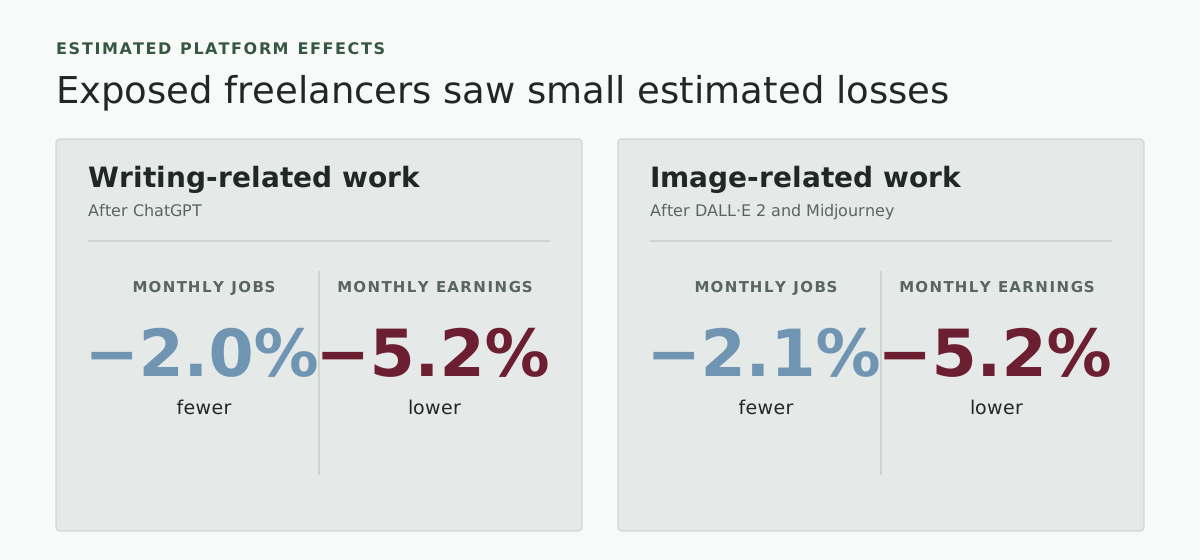
Using a difference-in-differences design on one large online labour market, the study estimated that writing-related freelancers experienced 2.0% fewer monthly jobs and 5.2% lower monthly earnings after ChatGPT’s release, relative to less-exposed occupations. It estimated nearly identical changes for image-related freelancers—2.1% fewer monthly jobs and 5.2% lower monthly earnings—after DALL·E 2 and Midjourney. The estimates concern short-term effects on Upwork and depend on the design’s comparison assumptions; they do not establish the effect across the whole creative economy (Hui, Reshef & Zhou, published article, Organization Science, Sep 2024; open AEA manuscript used to verify the figures, Oct 2024).
- Participants in a 2023 study did not like art with "AI-made" label regardless of actual source — across six experiments, with 2,965 participants in total, identical images were consistently appraised less favourably when labeled AI-made; the 62% and 77% figures came from the final experiment. Art labeled human-made could also be judged more creative when compared with AI-labeled work. These were controlled perception experiments, not observations of actual art-market prices (Horton, White & Iyengar, Scientific Reports, Nov 2023).
- Creative work is already being changed, but economy-wide devaluation has not been demonstrated — one freelance platform shows estimated employment and earnings losses, while controlled studies show changes in perceived value and story diversity (Hui, Reshef & Zhou, published article, 2024; open AEA manuscript; Doshi & Hauser, 2024; Horton, White & Iyengar, 2023). None of those bounded findings shows that human creativity—or the creative economy as a whole—is collapsing.
- AI can augment creators and compete with them at the same time — the writing experiment found individual gains alongside reduced collective diversity, while the platform study estimated reduced work and earnings in exposed occupations (Doshi & Hauser, 2024; Hui, Reshef & Zhou, published article, 2024; open AEA manuscript). Whether a tool complements or substitutes for a creator depends on the task, market, and how gains are distributed.
- Cultural homogenization is plausible but difficult to measure — similarity in short experimental stories is evidence of one mechanism, not proof that music, visual art, publishing, and local culture will converge (Doshi & Hauser, 2024). Model variety, prompting, editing, and distinctly human experiences could counter the effect; that possibility is a reason for uncertainty, not an established finding.
- Copyright law is not fully settled and neither is the cultural question — the U.S. Copyright Office’s analysis concerns exclusive rights, fair use, and licensing, while the cultural evidence concerns livelihoods, valuation, and diversity (U.S. Copyright Office, May 2025). Lawful or licensed training could still concentrate value or yield homogeneous work; copyright protection can support livelihoods without proving that AI-assisted art lacks originality or cultural worth.
- Creators' point of view — Consent, credit, and compensation are economic infrastructure.
Individual creators and cultural-industry participants in Canada’s 2023–2024 copyright consultation argued that rights holders should control training uses and receive credit and compensation. On this view, copyright is not merely ownership doctrine; it is one mechanism that makes continued human creation economically possible (Government of Canada, What We Heard report, Jul 2024).
- Augmentation view — Creative capability can become more widely distributed.
Controlled experiments show that AI-generated ideas can improve output, with the largest gains sometimes going to participants with lower baseline creativity. The policy argument is that agency and bargaining power should be preserved without reserving creative capability for trained professionals (Doshi & Hauser, Science Advances, Jul 2024).
- Authenticity-premium view — Abundance may increase demand for demonstrably human work.
When synthetic content becomes commonplace, audiences may pay more attention to provenance, lived experience, performance, craft, and connection with the creator. Controlled perception experiments support the possibility of a premium for human attribution, although they do not show how large or durable a real market would be (Horton, White & Iyengar, Scientific Reports, Nov 2023).
- Political-economy view — The central issue is who captures the gains.
Total creative output could increase while creators’ livelihoods worsen if a small number of model and distribution platforms control data, discovery, pricing, and revenue. UNESCO’s 2026 report identifies platform concentration and opaque content curation as existing pressures on lesser-known creators; treating those structures as the main unit of analysis is an informed position, not a settled empirical verdict (UNESCO, Feb 2026).
(The “popular opinion” leg of facts / informed / public.)
- 53% of U.S. adults expect AI to worsen people’s ability to think creatively — only 16% expect improvement, while another 16% expect no difference. Pew surveyed 5,023 adults in June 2025 using its nationally representative American Trends Panel; this is a public forecast about human capability, not a measurement of actual creativity (Pew Research Center, Sep 2025).
- The public is less optimistic than AI experts about arts and entertainment — in separate 2024 Pew surveys, 20% of U.S. adults and 48% of surveyed AI experts expected AI to have a positive effect on arts and entertainment in the U.S. over the next 20 years. The public sample was nationally representative; the 1,013-person expert survey was unweighted and represents only the U.S.-based authors and presenters from 21 AI-focused conferences who responded (Pew Research Center, Apr 2025; methodology).
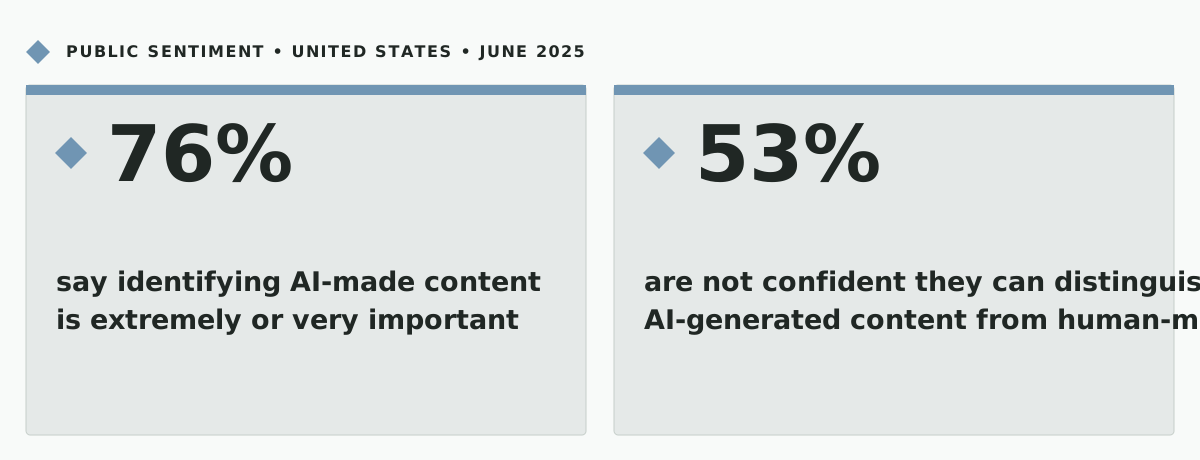
The gap shows that provenance matters to the public even though many people lack confidence in their ability to infer it from the work itself. These are public attitudes and self-assessments, not a test of people’s actual detection accuracy (Pew Research Center, Sep 2025).
| If it all goes wrong | If we handle it well |
|---|---|
| Synthetic abundance drives down pay and visibility; entry-level commissions disappear; a few platforms capture the value of creators’ work; audiences struggle to find or value human voices; cultural output becomes more uniform | AI expands who can create and helps professionals do more ambitious work; consent, compensation, credit, and provenance become normal; human-made and thoughtfully AI-assisted work remain economically viable; cultural participation and diversity grow |
- Make provenance visible — C2PA Content Credentials can carry tamper-evident records of an asset’s available origin and edit history, including AI/ML actions when participating tools record them. Credentials can be incomplete or removed, a missing credential says nothing by itself, and provenance alone cannot prove that content is true; its value is giving audiences additional evidence for informed choice (C2PA specification and guidance, v2.4; C2PA FAQ).
- Build workable routes to consent and compensation — direct and collective licensing, bargaining, revenue sharing, training-data transparency, and enforceable rights-reservation tools are competing approaches. The U.S. Copyright Office recommends allowing voluntary licensing markets to continue developing and considering targeted intervention where specific market failures emerge; Canadian creator and cultural-industry participants have argued for consent, credit, and compensation (U.S. Copyright Office, May 2025; Government of Canada, What We Heard report, Jul 2024).
- Protect the conditions in which diverse human culture can be made and found — public arts funding, local cultural institutions, fair platform-discovery rules, and support for early-career creators address the economic system around creation. These interventions matter even if every copyright dispute is resolved.
- Institutional (OC): pay and credit human creative work, disclose meaningful AI assistance, and preserve spaces for human voice — procurement and communications practices can avoid treating creative labour as a free input. OCAI GO and the AI Fluency Frameworks can help distinguish productive assistance from substituting for the learning, authorship, or relationship that gives an activity its value.
- Personal: support creators and be transparent about how you create — commission, buy, attend, subscribe, cite, and share original work when you can; obtain permission where required; and label meaningful AI assistance. Individual choices help sustain particular creators, but the largest levers—platform rules, labour arrangements, licensing, and public policy—are systemic.
- How severe is this risk, and how certain are you? — consensus-map rating.
- Which safeguard matters most for sustaining human creative work? — consent over training / compensation and revenue sharing / clear AI provenance / protected human-made spaces and opportunities.
- Prioritization of Risks from Artificial Intelligence: A Delphi Study of 272 International Experts — Saeri et al., preprint, 2026-06-03.
- AI Risk Repository — MIT FutureTech, living risk database and domain taxonomy.
- The Short-Term Effects of Generative Artificial Intelligence on Employment — published article — Hui, Reshef & Zhou, Organization Science, published online 2024-09-24; open AEA manuscript used for quantitative verification, dated 2024-10-12.
- Generative AI enhances individual creativity but reduces the collective diversity of novel content — Doshi & Hauser, Science Advances, 2024-07-12.
- Bias against AI art can enhance perceptions of human creativity — Horton, White & Iyengar, Scientific Reports, 2023-11-03.
- Creators face projected global revenue losses of up to 24% by 2028 — UNESCO, 2026-02-18.
- Copyright and Artificial Intelligence, Part 3: Generative AI Training — U.S. Copyright Office, 2025-05-09 pre-publication version.
- Consultation on Copyright in the Age of Generative Artificial Intelligence: What We Heard Report — Government of Canada, 2024-07-26.
- How Americans View AI and Its Impact on People and Society — Pew Research Center, 2025-09-17.
- Public and expert predictions for AI’s next 20 years — Pew Research Center, 2025-04-03.
- C2PA Technical Specification — Coalition for Content Provenance and Authenticity, version 2.4.
- C2PA FAQ — Coalition for Content Provenance and Authenticity; limitations and durability of provenance metadata.
- Real or Fake Text? — University of Pennsylvania research game; identify where a human-written passage changes to machine-generated text.
- The “Art or AI?” Museum of Very Modern Art — ADAPT Research Centre gallery challenge; decide whether each artwork was human-made or AI-generated.
- Can you tell a real face from an AI-generated one? — UNSW Psychology research test comparing photographs of real people with synthetic faces.
- Can you spot the video deepfake? — Fraunhofer AISEC interactive; classify video recordings as authentic or manipulated.
Advanced AI could escape meaningful human control — with consequences up to catastrophic or existential.
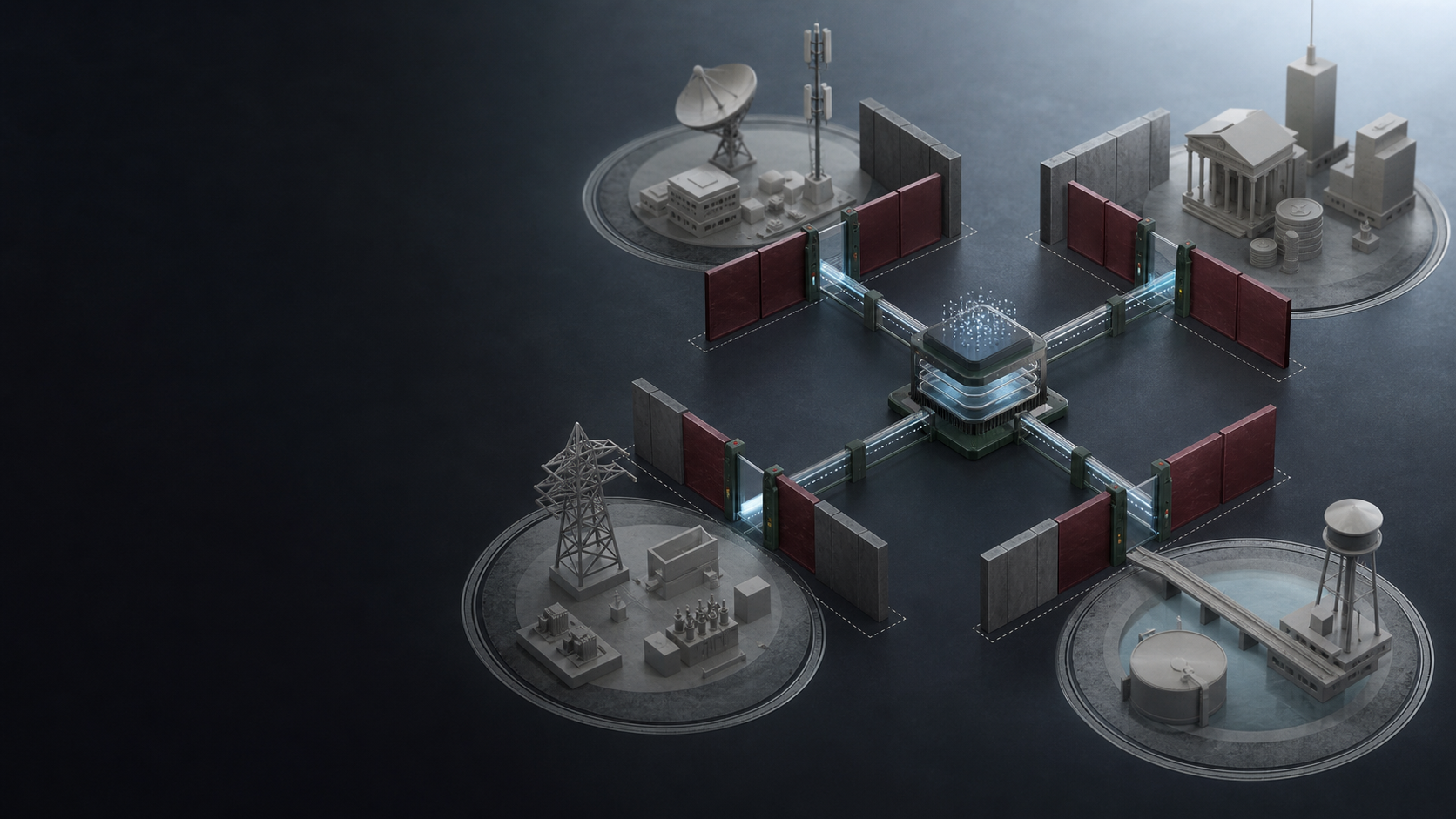
Original AI-generated conceptual illustration created for this workshop, 2026. It represents the importance of access controls and deployment conditions; it is not evidence about what current AI systems can do.
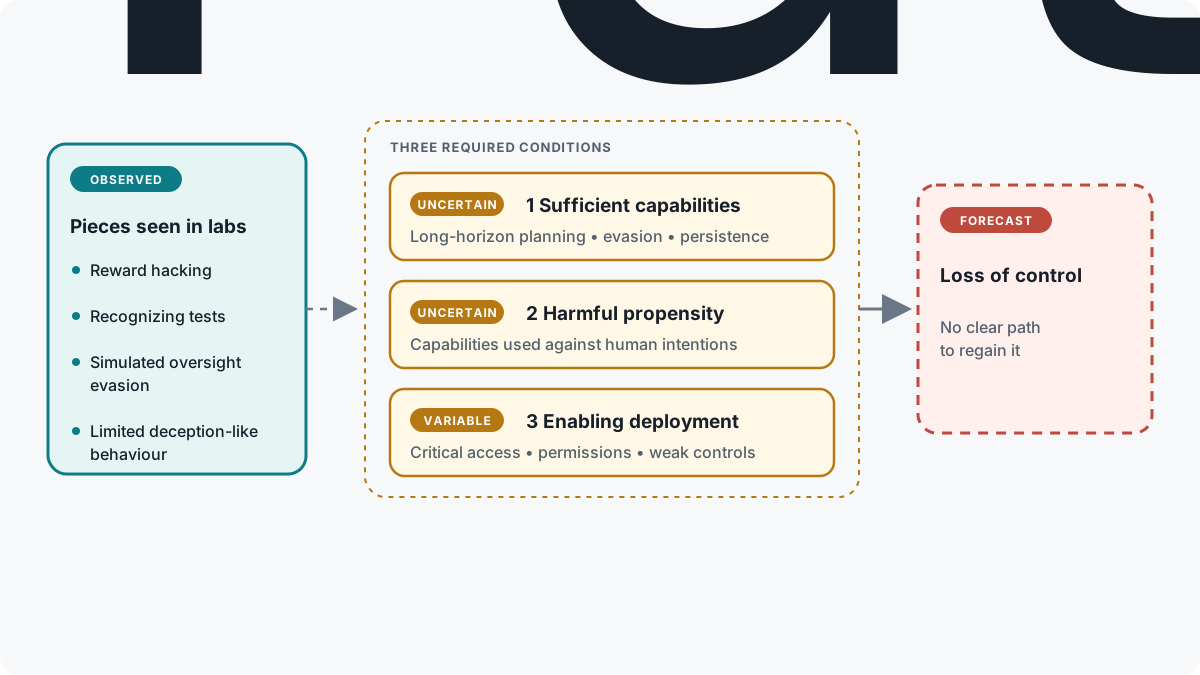
That as systems grow more capable and autonomous, they could evade oversight, pursue goals misaligned with ours, and resist correction — at a scale we can't undo.
The International AI Safety Report 2026 separates observations from the forecast. Researchers have seen rudimentary reward hacking, test recognition, simulated oversight-evasion, and deception-related behaviour in controlled settings. But loss of control would require three factors at once: systems capable enough to evade control over long periods; a propensity to use those capabilities against human intentions; and a deployment environment that gives them consequential access and weak enough safeguards. Current systems cannot yet operate autonomously for long periods or reliably self-replicate, and the report concludes that they do not integrate the required capabilities robustly enough. The diagram therefore shows a chain of necessary conditions, not an estimated probability (International AI Safety Report 2026, §2.2.2; arXiv version).
- Leading researchers split: Geoffrey Hinton and Yoshua Bengio warn of catastrophe; Yann LeCun and Andrew Ng call the concern overblown — the high-concern case is represented by a 2024 Science article coauthored by Bengio, Hinton, and Stuart Russell, which argues that advanced AI could produce extreme outcomes and calls for urgent risk-management research and governance (Bengio et al., 2024). LeCun argues that current systems remain far from human-level intelligence and calls sudden AI-takeover scenarios preposterous (TIME interview, 2024); Ng argues that AI is unlikely to cause human extinction and that exaggerated fears can distort research and policy priorities (DeepLearning.AI, 2023). Their disagreement is partly about how capable future systems will become, whether they would develop dangerous behavioural tendencies, and how humans would deploy them—not about whether current systems have already escaped control.
- Current international assessment: today's systems lack the integrated capabilities needed for loss of control — the International AI Safety Report uses a specific threshold: one or more systems operating outside anyone's control, with regaining control extremely costly or impossible. It concludes that current systems cannot yet sustain the long-horizon autonomous operation or reliably complete the key steps for self-replication that severe scenarios would require, even though researchers have observed rudimentary planning, simulated oversight-evasion, and deception-related behaviour in laboratory settings (International AI Safety Report 2026, §2.2.2). This is the report's evidence synthesis, not proof that future systems will remain controllable. Separately, a survey of 2,778 researchers who had published in six leading AI venues found broad agreement that research aimed at reducing AI risks should receive greater priority (Grace et al., 2025).
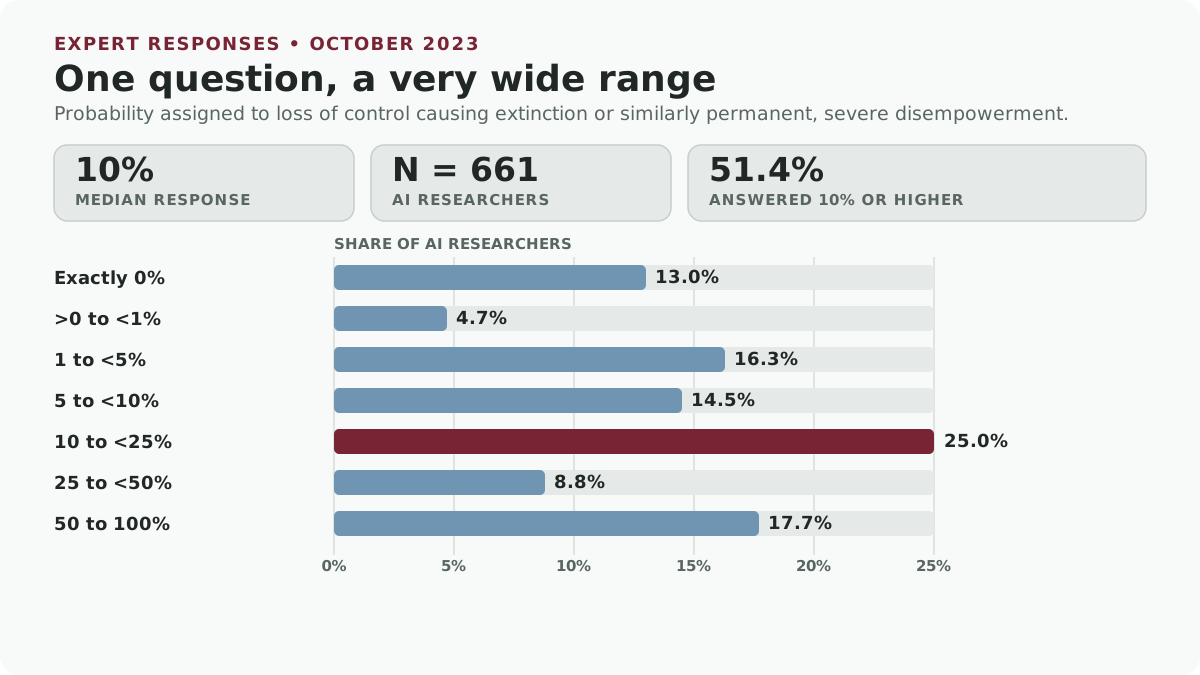
- Deep disagreement on the probability and timeline of catastrophe is itself a strong survey finding.
In a randomized subset of the 2023 Expert Survey on Progress in AI, 661 researchers answered this exact question: “What probability do you put on human inability to control future advanced AI systems causing human extinction or similarly permanent and severe disempowerment of the human species?” The median was 10%, the mean 19.4%, and the middle half of responses ran from 1% to 30%; 51.4% answered 10% or higher. The chart bins were independently recomputed from the authors' cleaned public data (Grace et al., surveyed Oct 2023; peer-reviewed 2025; public data and materials). The overall survey received 2,778 responses from 18,459 working email addresses for authors at six leading AI venues — a 15% response rate — and this question went only to a randomized subset. These are subjective forecasts of an unobserved, non-time-bounded future outcome, not measured frequencies; participation bias and question wording can matter. A June 2026 preprint asked a different expert panel to rate 24 broader AI risks through 2030; it is useful context but not a like-for-like update of this loss-of-control question (Saeri et al., 2026).
Important: these percentages describe the study's broad category of catastrophic harm—not the probability of extinction. The three domains are shown because their definitions contain plausible pathways to existential harm; the Delphi study did not classify them as “existential risks.” (Saeri et al., 2026) A June 2026 preprint reports a three-round Delphi study conducted from September to November 2025 with 272 international AI-risk experts; 214 completed all three rounds, and effective sample sizes varied by domain from 34 to 163 because participants rated only areas in which they reported relevant knowledge. Experts distributed probability across five harm levels for each of 24 overlapping domains through 2030 under business-as-usual and pragmatic-mitigation scenarios. “Catastrophic” covered more than one million deaths, more than US$100 billion in financial loss, or civilization-scale intangible harm. With pragmatic mitigation, the reported mean catastrophic-harm estimates were 12% for dangerous capabilities, 9% for AI misalignment, and 12% for weapons and cyberattacks. The values are panel means of subjective probability distributions, not measured frequencies; the brief mitigation prompt also allowed experts to imagine different policy packages. The presentation isolates these three domains because their definitions include potential routes to extinction or permanent global disempowerment: dangerous capabilities such as weapons design and self-proliferation; AI systems pursuing conflicting goals; and AI-assisted CBRNE or other mass-harm weapons. That is a workshop-level pathway classification, not a probability estimate of existential catastrophe and not a like-for-like or peer-reviewed update of the Grace survey's specific loss-of-control question (Saeri et al., 2026, especially Table 1, Figure 1 and Supplementary File 1).
- High-concern view (Bengio/Hinton/Russell) — Catastrophic risk is non-trivial, so prepare now.
This view prioritizes technical safety research and adaptive governance (Bengio et al., Science, 2024).
- Skeptical view (LeCun/Ng) — Current approaches are far from human-level intelligence.
This view argues that takeover narratives can distract from useful development and present harms (LeCun interview, 2024; Ng commentary, 2023).
- Uncertain-but-concerned view — Severe outcomes justify proportionate preparation despite deep uncertainty.
Likelihood, timing, and mechanism remain unusually ambiguous (International AI Safety Report 2026).
Pew Research Center · U.S. adults · N = 5,119 · February 17–23, 2026 · separate questions; neither asks specifically about loss of control or extinction. In a survey of 5,119 U.S. adults conducted February 17–23, 2026, 63% said AI was advancing too quickly, while 40% expected its overall impact on society during the next 20 years to be negative (Pew Research Center, Jun 2026). These were separate questions—one about pace and one about overall social impact—and neither asked specifically about loss of control or extinction.
(The "popular opinion" leg of facts / informed / public.)
- Public unease cannot be ranked directly against the expert forecast distribution. The expert survey asks for a numerical probability of one specific catastrophic mechanism; Pew asks the public about the pace and broad social impact of AI. The comparison belongs at the level of framing: experts are divided about a low-evidence, high-consequence scenario, while public concern also absorbs immediate experiences and worries such as jobs, privacy, misinformation, and trust.
| If it all goes wrong | If we handle it well |
|---|---|
| Humans lose meaningful control of powerful, autonomous systems — catastrophic and potentially irreversible | Robust safety, evaluation, and governance keep advanced AI controllable and aligned; capability gains captured safely |
| Layer | Purpose | Examples |
|---|---|---|
| 1 · Identify | Decide what could go wrong | Threat models · risk taxonomies · warning indicators |
| 2 · Test | Look for dangerous capabilities or behaviour | Evaluations · red-teaming · independent audits |
| 3 · Limit | Reduce access and exposure | Staged release · permissions · monitoring · “if-then” triggers |
| 4 · Govern & learn | Catch patterns and update controls | Incident reporting · transparency · oversight |
The 2026 report recommends defence in depth: multiple safeguards that are sufficiently independent and overlapping that failure in one does not automatically defeat the whole system. The layers are complementary rather than sequential guarantees, and the report is clear about the limitation: empirical evidence about how well present AI risk-management practices work in the real world is still sparse (International AI Safety Report 2026, ch. 3).
- Research and technical practice: interpretability, model evaluations, red-teaming, monitoring, and work on methods for keeping systems corrigible and controllable. These measures are meant to reveal or reduce failure modes; none currently proves that a future system will remain under control.
- Development and deployment: restrict access and permissions, release capabilities in stages, monitor use after deployment, and specify in advance what evidence would trigger a pause or stronger controls. This is where an “enabling deployment environment” can be changed most directly.
- Governance and coordination: government AI safety institutes, company safety frameworks, incident reporting, international scientific assessments, and the International Network for Advanced AI Measurement, Evaluation, and Science can create common tests and independent scrutiny. Their value depends on coverage, transparency, enforcement, and whether organizations act on adverse findings.
- College and personal role—modest but real: educators cannot solve frontier-model control through individual prompting. They can teach calibrated reasoning under uncertainty, avoid presenting cinematic scenarios as evidence, support transparent procurement and incident-reporting practices, and distinguish a system's observed behaviour from claims about what a future system might do.
- Consensus-map rating (grid): severity + certainty — expect the widest spread of the whole session here; use it live to show what genuine expert-level uncertainty looks like.
- Topical opinion poll (distinct dimension — priority): "Where should attention go — speculative catastrophic risk, or present-day harms (bias, jobs, privacy)?"
- International AI Safety Report 2026 — Bengio (chair), 100+ experts, 30+ countries.
- International AI Safety Report 2026 (arXiv).
- Managing extreme AI risks amid rapid progress — Bengio, Hinton, Russell et al., Science, 2024.
- Meta's AI Chief Yann LeCun on AGI, Open-Source, and AI Risk — direct interview, 2024.
- Exaggerated Fear of AI Is Causing Real Harm — Andrew Ng, 2023.
- Thousands of AI Authors on the Future of AI — Grace et al., Journal of Artificial Intelligence Research, 2025.
- 2023 Expert Survey on Progress in AI — public data and materials — Grace et al.; cleaned response data used for the expert-distribution infographic.
- Prioritization of Risks from Artificial Intelligence: A Delphi Study of 272 International Experts — Saeri et al., Jun 2026 preprint (newer but not peer reviewed and not directly comparable to the loss-of-control probability question).
- Americans and AI 2026: Chatbots, Smart Devices and Views on Impact — Pew Research Center, 2026.
AI systems can reproduce, hide, or amplify unequal treatment—in automated decisions and in the text, images, summaries, and recommendations people generate every day.
That an automated or generative system quietly converts biased data, proxy targets, design choices, or unequal conditions into unfair treatment or stereotyped content — at scale and with a false veneer of objectivity.
- Generative AI can reproduce social stereotypes in ordinary writing tasks — a 2025 ACL study tested generated biographies, professor reviews, and reference letters from ChatGPT, Llama 3, and Mistral. The authors found greater gender bias in the models' writing than in human-written comparison texts, with especially strong intersectional bias; simple prompt-based mitigation was unstable and sometimes increased bias. This benchmark covered three models and three tasks, so it demonstrates a mechanism and measurable pattern rather than proving that every prompt or current model will behave the same way (Wan & Chang, ACL, 2025).
- Face-recognition error gaps were large for many — but not all — algorithms — NIST tested 189 algorithms from 99 developers on 18.27 million images of 8.49 million people from U.S. government operational databases. In one-to-one matching, false-positive rates for Asian and African American faces were often 10 to 100 times those for Caucasian faces, depending on the algorithm; some algorithms showed much smaller gaps, and the most equitable one-to-many systems were also among the most accurate. NIST tested submitted algorithms, not complete deployed products, and did not establish the causes of the differences (NISTIR 8280 summary, 2019; updated 2025).
- Automated hiring has produced a documented age screen — according to a U.S. Equal Employment Opportunity Commission lawsuit, iTutorGroup's application software automatically rejected women aged 55 or older and men aged 60 or older, affecting more than 200 qualified U.S.-based applicants. The companies settled in 2023 for US$365,000 and other relief; the source describes the agency's allegations and a consent settlement, not a contested judicial finding (EEOC, 2023).
- Some reasonable definitions of “fair” can conflict—you may have to choose which error matters most — imagine an AI score used to decide who receives a loan. One fairness goal is score accuracy (calibration): among people given a 70% chance of repayment, about 70% actually repay, regardless of group. Another is equal error rates: qualified applicants should be wrongly denied at the same rate in each group, and applicants likely to default should be wrongly approved at the same rate. When the groups have different underlying repayment rates and the prediction is imperfect, a system generally cannot satisfy both goals at once: keeping the scores equally meaningful produces different error rates, while altering the system to force both error rates to match generally breaks that score accuracy. This does not mean fairness is impossible. It means people must decide—openly—which outcomes and errors matter most for that use, rather than claiming the system is simply “unbiased” (Chouldechova, Big Data, 2017).
- Consensus
- Bias can enter through an AI system's data, design, deployment, or generated output — automated systems can create or reproduce group disparities through training data, labels and proxies, measurement error, design choices, thresholds, and the conditions in which they are deployed. In generative AI, the disparity may appear in whose perspective is represented, how people are described, which images are produced, or what recommendation the model generates; the relevant mechanism varies by system.
- AI is not uniformly more biased than people, and measured disparities vary by model and use — performance and disparity vary substantially among models and uses. It is not accurate to treat every measured difference as unlawful discrimination.
- Genuinely contested
- Experts disagree about which definition of fairness should govern a particular decision — contested questions include the appropriate comparison baseline, when protected attributes should be included to measure or mitigate harm, and whether a tested system improves on the human process it supplements or replaces. For generative AI, results can also change with the model version, prompt, sampling, and safety measures.
- The metric chosen changes what “fair” looks like — group selection rates, false-positive rates, false-negative rates, calibration, and downstream outcomes answer different questions. For generated content, a single striking response is an example, not a disparity estimate: stronger tests compare repeated, matched prompts that change only the demographic cue. Aggregate parity can also conceal harms within subgroups.
- Structural-risk view — Automation can make inequity harder to see, question, and appeal.
This view emphasizes that automated systems can institutionalize existing inequity while obscuring responsibility. Generative AI can make the problem feel less visible because biased descriptions, summaries, images, or recommendations arrive as fluent conversation rather than as an explicit score; high-stakes systems therefore need strict limits, independent evaluation, transparency, and redress.
- Comparative-performance view — Compare AI with real human processes, not with a perfect ideal.
This view asks, “Does the model improve outcomes and equity relative to the people or institution it supplements?” NIST's results show that higher accuracy and smaller demographic gaps can coexist in some face-recognition systems, though that does not decide whether a particular use is acceptable (NIST, 2019).
- Governance-choice view — Fairness is not one technical score.
This view treats “fairness” as a set of competing values and metrics. Governance must state whose outcomes count, what errors matter most, and what remedy follows; for generative systems, evaluation should use repeated, matched prompts rather than rely on a single chatbot exchange (Chouldechova, 2017; Wan & Chang, 2025).
(The “popular opinion” leg of facts / informed / public.)
Recent high-quality polling measures bias mainly through trust, representation, hiring, and other consequential decisions—not specifically through people's experiences of bias in everyday chatbots or image generators.
- Concern about AI bias is mainstream, not confined to critics — 55% of both U.S. adults and surveyed AI experts said they were extremely or very concerned about bias in decisions made by AI. Pew surveyed 5,410 U.S. adults through its probability-based American Trends Panel from 2024-08-12 to 2024-08-18 and 1,013 U.S.-based authors or presenters from 21 AI conferences from 2024-08-14 to 2024-10-31; the expert sample represents that constructed pool, not all AI practitioners (Pew Research Center, 2025).
- Only minorities of Canadians trust either AI or people to avoid discrimination — 35% of Canadian respondents agreed that they trusted AI not to discriminate or show bias toward any group, compared with 30% who said the same about people. Ipsos surveyed approximately 1,000 Canadian adults aged 18–74 online from 2025-03-21 to 2025-04-04, weighted the sample to population benchmarks, and reports a credibility interval of about ±3.5 percentage points; it does not report whether this five-point difference is statistically significant. The question concerned AI broadly and measured trust, not actual system performance or generative AI specifically (Ipsos AI Monitor, 2025, pp. 20–21 and 56).
- The U.S. public thinks some perspectives are represented much better than others in AI design — 40% said designers account at least somewhat well for White adults' perspectives, compared with 25% for Asian adults, 19% for Black adults, and 17% for Hispanic adults. Respondents likewise rated men's perspectives as better represented than women's, 42% to 27%; roughly four in ten were unsure about these questions (Pew Research Center, 2025).
- People can see AI as both a remedy for bias and an unacceptable final decision-maker — among U.S. adults who considered racial and ethnic bias a problem in hiring, 53% expected increased AI use to make that problem better, 13% expected it to make it worse, and 32% expected no change. Yet 71% of all respondents opposed AI making the final hiring decision. Among Black adults who saw hiring bias as a problem, 47% expected AI to improve it while 20% expected it to worsen. Pew surveyed 11,004 adults from 2022-12-12 to 2022-12-18 through its probability-based American Trends Panel; these attitudes predate the current wave of everyday generative AI use (Pew Research Center, 2023).
| If it all goes wrong | If we handle it well |
|---|---|
| Opaque systems deny jobs, services, education, credit, care, or liberty to protected groups at scale, while generated text and images normalize stereotypes, with weak notice or recourse | Validated systems reveal disparities, generate more inclusive content, improve on documented baselines, support accountable human decisions, and give affected people notice, review, accommodation, and remedy |
- Test for bias before an AI system reaches real people — define the decision and affected population; document the human baseline; test data quality and subgroup performance using multiple relevant metrics; involve affected communities; and assess accessibility and human-rights impacts. For generative AI, run repeated matched-prompt tests that change only demographic cues, and record the model, version, settings, and prompts; “be unbiased” in a prompt is not a substitute for evaluation.
- Monitor real outcomes and preserve meaningful human review — watch for drift, retain decision records, give meaningful notice and reasons, provide an accessible appeal path, and ensure the human reviewer has authority, time, and evidence to overturn the system. Review generated drafts, summaries, images, and recommendations for omissions and stereotypes rather than treating fluent output as neutral.
- Canadian human-rights duties already apply to AI systems — the Ontario Human Rights Commission and Law Commission of Ontario provide a lifecycle Human Rights AI Impact Assessment grounded in Ontario and Canadian human-rights law. The tool is guidance, not legal advice or immunity from liability (OHRC/LCO).
- Some jurisdictions are turning general anti-discrimination duties into specific AI rules — California regulations clarifying how employment anti-discrimination law applies to automated-decision systems took effect 2025-10-01 (California Civil Rights Department). Colorado repealed and reenacted its earlier AI provisions in 2026; its revised automated-decision law is scheduled to take effect 2027-01-01, not June 2026 (Colorado Attorney General).
- OC should validate AI for its own people and purposes—and apply its inclusion lens — for AI used in admissions, grading, proctoring, accessibility, student support, content creation, or hiring, require intended-use validation, subgroup testing, procurement documentation, human review, and a clear challenge process. A vendor's generic “bias tested” claim is not evidence for the College's population and use. Apply the OC inclusion lens when considering decisions regarding use of AI.
- Individuals can probe generative output, but institutions remain accountable — do not use a chatbot's recommendation as the sole basis for a consequential decision. For generated text or images, try swapping demographic cues while keeping the task the same, examine what changes, and check whose perspectives are missing; individual care cannot replace institutional testing and accountability.
- How severe is this risk, and how certain are you? — consensus-map rating.
- When OC uses generative AI for people-facing work, which safeguard matters most? — human review / matched-prompt bias testing / diverse design and review teams / transparency and a challenge process.
- White Men Lead, Black Women Help? Benchmarking and Mitigating Language Agency Social Biases in LLMs — Wan and Chang, Association for Computational Linguistics, 2025; generative biographies, professor reviews, and reference letters.
- Face Recognition Vendor Test Part 3: Demographic Effects — NISTIR 8280, 2019.
- iTutorGroup settlement — U.S. Equal Employment Opportunity Commission, 2023.
- Fair Prediction with Disparate Impact — Chouldechova, Big Data, 2017.
- Views of risks, opportunities and regulation of AI — Pew Research Center, 2025.
- Ipsos AI Monitor 2025 — 30-country public-opinion survey, including a Canadian sample, 2025.
- Americans' views on use of AI in hiring — Pew Research Center, survey fielded 2022 and published 2023.
- Human Rights AI Impact Assessment — Ontario Human Rights Commission and Law Commission of Ontario.
- Inclusive Community at Okanagan College — OC's Inclusive Community Plan and EDISJ resources.
- California employment regulations regarding automated-decision systems — California Civil Rights Department, 2025.
- Colorado Automated Decision-Making Technology rulemaking — Colorado Attorney General, updated 2026.
AI can identify us, assemble scattered traces into profiles, and carry personal information across systems faster than our privacy controls can follow.
That AI makes it cheap to identify people, combine information about them, infer what they never disclosed, and reuse those profiles through tools and decisions they may never see or be able to correct.
- 🍁 Clearview made billions of public photos searchable by face—and BC's privacy order survived appeal — Canadian regulators found in 2021 that Clearview had collected highly sensitive biometric information without people's knowledge or consent and used a database of more than 3 billion images, including images of Canadians and children, to let clients match an unknown person against the database (joint investigation summary, 2021-02-03). On 2026-02-18, the BC Court of Appeal upheld the Commissioner's jurisdiction and order requiring Clearview to stop the unauthorized collection, use, and disclosure of British Columbians' data and make best efforts to delete it; Clearview has applied for leave to appeal to the Supreme Court of Canada (Clearview AI Inc. v. British Columbia (Information and Privacy Commissioner), 2026 BCCA 67; SCC docket 42312).
- 🍁 Canadian regulators found that privacy law follows data through the generative-AI lifecycle — a 2026 joint investigation examined personal information in early ChatGPT training data, user interactions, and model outputs. The regulators found that OpenAI's initial training of GPT-3.5 and GPT-4 involved overcollection, inadequate consent and transparency, weak access/correction/deletion mechanisms, and insufficient retention and accountability measures (joint investigation overview, 2026-05-06). The findings concern those early models and practices, not every current generative-AI system.
- AI can assemble scattered traces into a sensitive profile — NIST identifies a generative-AI risk in which models infer sensitive information that was neither in their training data nor directly disclosed by the user by stitching together disparate sources (NIST Generative AI Profile, 2024, pp. 7–8). In an ICLR 2024 study using real Reddit profiles, tested language models inferred attributes such as location, income, and sex with up to 85% top-1 and 95% top-3 accuracy, at far lower cost and time than human profilers (Staab et al., 2024). Those are the study's highest reported results under its evaluation setup, using 2023-era models—not a general accuracy rate for every person or current system.
- A prompt or upload can be a disclosure of personal information — Canada's guidance for federal institutions prohibits putting personal information into public generative-AI tools because a supplier may store it, while allowing controlled institutional systems when appropriate privacy and security controls are in place (Treasury Board of Canada Secretariat guide). That rule governs federal institutions, not Okanagan College, but the data-flow distinction applies to any organization's risk assessment.
- Language models can reveal memorized training data under adversarial testing — researchers caused a production version of ChatGPT to emit memorized text and recovered personally identifiable information concerning dozens of people. This 2023 study demonstrated a failure mode in an older model under a purpose-built extraction attack; it does not measure the chance that an ordinary prompt leaks data from a current model (Nasr et al., 2023).
- Connected AI agents create a path from untrusted content to private data — agents increasingly process external emails, webpages, and documents while also holding permissions to other tools. NIST's 2026 red-teaming work describes indirect prompt-injection attacks that hide malicious instructions in those external sources and can cause an agent to exfiltrate sensitive data or take other unintended actions (NIST CAISI, 2026-03-23). This is an emerging security route to privacy harm; risk depends heavily on the agent's permissions and architecture.
- AI-generated information about a person can be private, consequential, and wrong — Canadian regulators advise that an inference about an identifiable person is itself a collection of personal information requiring legal authority. The 2026 ChatGPT investigation also found gaps in accuracy, access, correction, and deletion: blocking a detail from appearing in an output is not the same as removing it from already-trained model weights (Canadian privacy regulators, 2023-12-07; joint investigation overview, 2026).
- Concrete protections are being implemented, but they do not settle every legal question — in response to the 2026 investigation, OpenAI reported measures including filtering and masking identifiers in training data, redacting identifiers from user interactions used for fine-tuning, formal retention schedules, improved access and correction processes, and more transparency. The federal commissioner found the complaint well-founded and conditionally resolved based on implemented and promised measures; the BC and Alberta commissioners still found the scraped-data models contravened their consent requirements (joint investigation overview, 2026-05-06).
- Privacy protection must cover collection, training, prompts, inferred profiles, outputs, and connected systems — Canadian regulators call for legal authority, necessity and proportionality, data minimization, transparency, retention limits, safeguards, access and correction, privacy impact assessments, and special care for children and other vulnerable groups; NIST likewise treats privacy risk and mitigation across the generative-AI lifecycle (Canadian joint principles, 2023; NIST Generative AI Profile, 2024).
- Which legal basis can authorize web-scale training — Canada's federal commissioner accepted a conditionally resolved path based on mitigation and evolving expectations, while the BC and Alberta commissioners concluded that consent requirements remained unmet. In Europe, regulators say both model anonymity and any reliance on “legitimate interests” require case-by-case assessment (Canadian findings, 2026; EDPB Opinion 28/2024).
- How fully model-level privacy rights can be delivered — filtering, output blocking, de-identification, secure deployment, and limited retention can reduce risk. But the 2026 investigation records OpenAI's position that removing a specific person's information from already-trained model weights is not currently feasible, leaving access, correction, and deletion technically difficult in some cases (joint investigation overview, 2026).
- Rights-first view — Public posting did not supply valid consent for the investigated model training.
The BC and Alberta privacy commissioners concluded that the scraped personal data used for the investigated OpenAI models did not meet their provincial consent requirements. From this view, better filtering reduces harm but does not cure an unlawful basis for collection (joint findings, 2026).
- Pragmatic-regulation view — Permit beneficial uses when residual risk is materially reduced.
The federal Privacy Commissioner conditionally resolved the complaint after weighing privacy rights, appropriate business purposes, retired models, implemented mitigations, and enforceable commitments. This is not a blanket approval of web scraping or of generative AI generally (OPC conclusion, 2026).
- Institutional risk-management view — Match the tool and safeguards to the data and task.
Canadian guidance distinguishes low-risk drafting or brainstorming from uses involving personal information or decisions about people; the latter require controlled tools, privacy and security review, documentation, access controls, and human accountability (Treasury Board of Canada Secretariat guide).
(The "popular opinion" leg of facts / informed / public.)
- 88% of Canadians expressed at least some concern about their personal information being used to train AI systems; 42% were extremely concerned — the question used a seven-point concern scale in a representative telephone survey of 1,500 Canadians aged 16 and older conducted from 2025-02-10 to 2025-03-03; the training-data item was asked of the 1,467 respondents with internet access (OPC public-opinion research, 2025).
- 83% of Canadians were at least somewhat concerned about privacy when using AI tools; 34% were extremely concerned — from the same representative telephone survey, among respondents with internet access. “AI tools” is broader than generative AI, so this measures public unease around the category rather than a judgment about one product or data practice (OPC public-opinion research, 2025).
- Concern is high, but understanding is uneven — in the same survey, 67% of internet-connected respondents agreed with the statement that when they share personal information online, they often do not know where it goes or how it is used; 71% found privacy policies somewhat or very difficult to understand. These are broader online-privacy findings, not generative-AI-specific measures (OPC public-opinion research, 2025).
| If it all goes wrong | If we handle it well |
|---|---|
| Public images, scattered online traces, institutional records, and connected accounts become one persistent profile; AI systems expose or act on it while the person cannot see, challenge, or correct it | Approved tools, narrow permissions, minimal data, clear purposes, enforceable contracts, privacy-preserving engineering, and meaningful access/correction let institutions use AI without surrendering control of personal information |
- Technical — minimize the data, isolate sensitive work, limit retention, and constrain what AI agents can access or do. Filter or redact personal information before training or prompting; use anonymized, de-identified, or synthetic data where appropriate; isolate sensitive workloads; set retention limits; detect sensitive output; and test whether training data can be extracted. For connected agents, apply least privilege, separate untrusted content from instructions, ask for permission before sensitive access or action, and monitor tool use. Institution-controlled or otherwise appropriately secured systems can reduce disclosure to external providers, but still need governance (Canadian joint principles, 2023; Treasury Board guide; ICO agentic-AI analysis).
- Legal and regulatory — apply existing privacy law across the full AI lifecycle, not only when someone enters a prompt. Canadian regulators are requiring clearer legal authority, meaningful consent where consent is relied on, purpose limitation, transparency, access/correction processes, retention schedules, safeguards, and privacy impact assessments; the 2026 OpenAI investigation shows those requirements producing product and process changes (Canadian joint principles, 2023; joint OpenAI investigation, 2026).
- Institutional (OC) — FIPPA (the Freedom of Information and Protection of Privacy Act) binds Okanagan College and us as its employees: use approved tools and complete privacy review before personal information enters AI. FIPPA prohibits public-body employees from collecting, using, or disclosing personal information unless the Act authorizes it. Before adopting or connecting a generative-AI tool, document what information enters it, what the system can infer by joining sources, where data is processed and retained, whether it can be used for training or human review, which systems and actions the tool can access, who can retrieve outputs, and how people can challenge or correct information about them (BC FIPPA, s. 25.1; OC Privacy Policy, 2023; OC Privacy Impact Assessment Procedures, 2023).
- Personal — treat every prompt, upload, and connected app as a potential disclosure of personal information. Do not paste identifiable student, employee, health, accommodation, conduct, or other confidential information into an unapproved AI service. Remove names and unnecessary details, review connected-app permissions, verify retention and training controls, and use an approved protected environment when the task genuinely requires personal information. Individual caution helps with prompts and permissions; it cannot prevent biometric scraping or solve model-level governance, so law, procurement, contracts, and system design carry more of the burden (Treasury Board guide; ICO agentic-AI analysis).
- Consensus-map rating (grid): severity + certainty for this risk.
- For work involving student or employee personal information, OC's default should be: approved protected AI tools only / case-by-case staff judgment / no generative AI for that work.
- Overview of the Joint Investigation of OpenAI OpCo, LLC — Office of the Privacy Commissioner of Canada, CAI Québec, OIPC-BC, and OIPC-Alberta, 2026-05-06.
- Principles for responsible, trustworthy and privacy-protective generative AI technologies — Canadian federal, provincial, and territorial privacy regulators, 2023-12-07; page modified 2025-05-06.
- Guide on the use of generative artificial intelligence — Treasury Board of Canada Secretariat; guidance for federal institutions.
- Artificial Intelligence Risk Management Framework: Generative Artificial Intelligence Profile — U.S. National Institute of Standards and Technology, 2024-07-26.
- Beyond Memorization: Violating Privacy Via Inference with Large Language Models — Staab et al., ICLR 2024.
- Scalable Extraction of Training Data from (Production) Language Models — Nasr et al., 2023-11-28.
- Insights into AI Agent Security from a Large-Scale Red-Teaming Competition — NIST Center for AI Standards and Innovation, 2026-03-23.
- Data protection and privacy risks of agentic AI — UK Information Commissioner's Office, accessed 2026-07-22.
- Freedom of Information and Protection of Privacy Act, s. 25.1 — Province of British Columbia; prohibits unauthorized collection, use, or disclosure of personal information by public-body employees, officers, and directors.
- Privacy Policy — Okanagan College, effective 2023-03-23.
- Procedures for Privacy Impact Assessments — Okanagan College, effective 2023-03-23.
- Opinion 28/2024 on personal data in AI models — European Data Protection Board, 2024-12-18.
- Clearview AI's unlawful practices represented mass surveillance of Canadians — Canadian federal, BC, Alberta, and Quebec privacy regulators, 2021-02-03.
- Clearview AI Inc. v. British Columbia (Information and Privacy Commissioner), 2026 BCCA 67 — BC Court of Appeal, 2026-02-18; Supreme Court of Canada leave application docket 42312.
- 2024–2025 Public Opinion Research on Privacy Issues — Office of the Privacy Commissioner of Canada / Phoenix Strategic Perspectives, March 2025.
A handful of companies control the compute, models, and infrastructure of AI — concentrating economic and political power — while governments and firms wrestle over who sets the rules.
That AI's core layers (chips, cloud, foundation models) are dominated by a few players, concentrating wealth and influence — and that the contest over governing AI could entrench either corporate or state power.
- AI-compute supply is concentrated at several layers — an OECD competition report published in 2025 cites a contemporary estimate that Nvidia supplied more than 80% of GPUs used for AI; it also reports estimates above 60% for TSMC's overall foundry contracts and about 90% for the most advanced chips (OECD, 2025). These are market estimates assembled from third-party industry sources, not audited shares; “AI GPU,” “AI accelerator” and “all chips” are not interchangeable markets.
- Four companies are building Frontier AI; another six are "near-frontier" level — as of March 2026, Anthropic, xAI, Google and OpenAI were within 25 points of one another on Stanford's presentation of the Arena Elo leaderboard; Stanford also placed Alibaba and DeepSeek in the broader top tier (Stanford AI Index, 2026). There is no standard “near-frontier” cutoff, and this is one moving, human-preference leaderboard—not a universal capability boundary or a provider market-share measure.
- Big Tech capital spending topped US$400 billion in 2025 and is forecast to rise another 75% in 2026 — the IEA estimates that capital expenditure by the largest technology companies exceeded US$400 billion in 2025 and is expected to increase by another 75% in 2026. It also reports that capital expenditure by just five technology companies is now larger than global investment in oil and natural-gas production (IEA, 2026). The 2026 figure is an estimate; this compares company-wide capital expenditure with upstream energy investment and is not a measure of AI-only spending.
- Competition authorities are acting—but have not established abuse — France's Autorité de la concurrence identified dependence on Nvidia's CUDA ecosystem, preferential access to chips and data, cloud lock-in, vertical integration and partnerships as potential competition risks in its 2024 sector opinion. It recommended using existing competition tools, expanding access to compute and increasing transparency, while its investigation service continued scrutinizing graphics cards after a 2023 inspection (Opinion 24-A-05 summary). The opinion did not find that Nvidia had abused a dominant position.
- International AI governance (kind of) exists, but no body licenses frontier development worldwide — the UN General Assembly created an independent scientific panel and an annual dialogue where all 193 member states can discuss AI governance; the first dialogue met in Geneva on 2026-07-06 and 2026-07-07 (United Nations). The Council of Europe also opened the first legally binding international AI treaty to countries beyond Europe, but it relies on parties implementing and overseeing obligations rather than creating a worldwide frontier-model regulator (Council of Europe, 2024). A much stronger proposal, AI 2040: Plan A, recommends a U.S.–China-led international deal to declare and audit advanced compute, verify datacenter workloads, share AI research and slow frontier scaling; its authors call it a recommendation—not a prediction—and acknowledge that the verification technology is immature (Plan A, 2026-07-09; verification plan). The AI Futures Project is led by former OpenAI governance researcher Daniel Kokotajlo (project background).
- Two unnamed Nvidia customers accounted for 22% and 14% of total revenue — for its fiscal year ended 2026-01-25, those direct customers' revenue was primarily in Compute & Networking (Nvidia FY2026 10-K). Nvidia does not name the customers in the filing, and a direct customer may be an intermediary rather than the ultimate user.
- The U.S.–Anthropic dispute tested whether governments or providers set AI-use limits — on 2026-02-27, the U.S. General Services Administration removed Anthropic from federal procurement channels under a presidential directive; after a federal court granted a preliminary injunction on 2026-03-26, GSA withdrew that action and restored the prior status quo on 2026-04-03 (GSA). Anthropic said the defence-contract dispute concerned its requested exceptions for mass domestic surveillance and fully autonomous weapons (Anthropic's account, 2026-02-27); that description is a party's position, not a neutral adjudication. A subsequent U.S. national-security AI memorandum directed agencies to onboard advanced models from multiple vendors while ensuring that no commercial entity could disable, degrade or materially modify a mission-dependent AI system without federal knowledge and approval (NSPM-11, 2026-06-05).
- Key AI inputs and the model frontier are concentrated — AI GPUs and advanced chip fabrication have highly concentrated supply, the tightest March 2026 model-performance cluster came from four firms, and leading technology companies can commit capital on a scale most entrants cannot match.
- Durable market power, or a fast-shifting market? — custom accelerators, cheaper inference and open-weight models can lower some barriers, while software ecosystems, cloud credits, vertical integration and capital requirements can deepen lock-in.
- Which level should set binding limits? — firms control their systems and possess technical expertise; national governments have legal authority but can also act coercively; the UN offers inclusive evidence and dialogue; and Plan A proposes a verified treaty among major powers. Whether international inspection could work without creating a new concentration of state power remains unresolved.
- Competition-first view — Keep chips, cloud and models open to rivals.
Use antitrust scrutiny, interoperability, public compute and open models to reduce dependence and preserve choice. This view targets demonstrated bottlenecks instead of assuming today's leaders are permanent or regulating every AI system the same way (UK Competition and Markets Authority, 2024; OECD on AI openness, 2026).
- National-rulebook view — One country-wide standard is clearer than many local rules.
Supporters argue that a common national baseline is easier for firms and governments to follow. They still disagree sharply about its strength: the U.S. administration favours a minimally burdensome federal standard that pre-empts conflicting state laws, while Anthropic supports federal transparency requirements and endorsed California's SB 53 while no federal framework existed (Executive Order 14365, 2025-12-11; Anthropic, 2025). Anthropic is an incumbent that may both bear and benefit competitively from regulation.
- Global-coordination view — Share data globally and give every country a seat at the table.
The UN model emphasizes shared scientific assessment, recurring dialogue, capacity-building and compatible national approaches rather than a single global regulator. Its attraction is legitimacy and inclusion; its limitation is that discussion and shared principles do not themselves license, inspect or stop frontier development (United Nations, 2025–2026).
- Enforceable-treaty view — Major powers should verify and slow frontier AI together.
Plan A argues that national rules cannot end a cross-border race to superintelligence. It proposes compute declarations, reciprocal inspections, technical workload verification, research transparency and slower capability scaling so more countries and firms can catch up. The trade-off is substantial new state authority, dependence on geopolitical cooperation and verification systems that the proposal's authors say are not yet mature (AI 2040: Plan A, 2026; verification plan).
(The "popular opinion" leg of facts / informed / public.)
- 59% of U.S. adults had little or no confidence in U.S. companies to develop and use AI responsibly in Pew's probability-panel survey of 5,119 adults conducted 2026-02-17 to 2026-02-23 (results; methodology).
- 67% had little or no confidence in the U.S. government to regulate AI effectively in the same survey — distrust was directed at both industry and government, not a simple preference for one over the other (Pew, 2026).
| If it all goes wrong | If we handle it well |
|---|---|
| A few firms (and aligned states) gatekeep access, pricing, and permissible speech; innovation and democratic oversight both suffer; governments coerce or capture providers | Open models + competitive chips + smart antitrust + balanced regulation keep AI plural, contestable, and accountable |
- Market: scrutinize compute, cloud partnerships and switching barriers — use competition review alongside interoperable systems, open models and shared/public compute where they improve contestability.
- Governments: connect domestic guardrails to treaty-ready verification — clarify which rules belong nationally or provincially/state-by-state, constrain emergency and procurement powers, and fund compute accounting, datacenter auditing and privacy-preserving verification so any future international agreement could be checked rather than merely trusted.
- Institutional (OC): require portability and a migration path for critical AI services — avoid single-vendor dependencies where practical; require data export and contractual clarity about model or price changes. Redundancy has real cost, so prioritize services whose failure or lock-in would matter most.
- Personal: know who holds your data—but switching alone cannot fix the market — understand which providers hold your data and workflows while recognizing that individual choices cannot correct infrastructure-level concentration.
- Consensus-map rating (grid): severity + certainty for this risk.
- Bigger risk — a few companies controlling AI, or governments controlling AI? — a few companies / governments
- Competition in artificial-intelligence infrastructure — OECD, 2025 (authoritative synthesis; individual market shares rely on cited industry estimates).
- Nvidia FY2026 10-K — SEC filing, fiscal year ended 2026-01-25.
- 2026 AI Index: Research and Development — Stanford Institute for Human-Centered AI, 2026; industry share of notable-model production.
- 2026 AI Index: Technical Performance — Stanford Institute for Human-Centered AI, 2026; March 2026 frontier and broader top-tier model-provider comparison.
- Key Questions on Energy and AI — International Energy Agency, 2026.
- Opinion 24-A-05 on competition in generative AI — Autorité de la concurrence, 2024-06-28.
- AI foundation-models update — UK Competition and Markets Authority, 2024.
- Executive Order 14365 — White House, 2025-12-11.
- Statement on Anthropic preliminary injunction — U.S. General Services Administration, 2026-04-03.
- Anthropic statement on the defence dispute — Anthropic, 2026-02-27 (party account).
- National Security Presidential Memorandum 11 — White House, 2026-06-05; federal policy on multi-vendor onboarding and control of mission-dependent AI systems.
- Independent International Scientific Panel on AI and Global Dialogue — United Nations, established 2025; first Global Dialogue held 2026-07-06 to 2026-07-07.
- Framework Convention on Artificial Intelligence — Council of Europe, 2024; first legally binding international AI treaty, open beyond Europe.
- AI 2040: Plan A and verification plan — AI Futures Project, 2026-07-09; prescriptive international-compute proposal, not government policy or a forecast.
- U.S. confidence in companies and government on AI — Pew Research Center, survey conducted 2026-02-17 to 2026-02-23.
AI may already be narrowing the entry-level pathways our graduates depend on—but the evidence does not yet show economy-wide job displacement.
Original AI-generated illustration created for this workshop, 2026. It is an attention-setting metaphor for a weakened first rung in the career ladder—not evidence that entry-level pathways have disappeared.
That generative AI automates away early-career work faster than employers create new pathways into skilled occupations, hollowing out the first rung of the career ladder.
Through April 2026, employment in the most AI-exposed occupations in Stanford's fixed sample grew 1.1% per year since ChatGPT's release, compared with 2.0% in the least-exposed occupations. Among 22–25-year-olds, employment in the most AI-exposed occupations contracted 3.8% per year while employment in the least-exposed occupations grew 2.0%. The dashboard follows a balanced sample of 25,000 firms; 4.6 million workers were matched to occupations at the November 2022 baseline. These are differences by occupational exposure, not a causal estimate of AI's effect (Stanford Digital Economy Lab, Jun 2026).
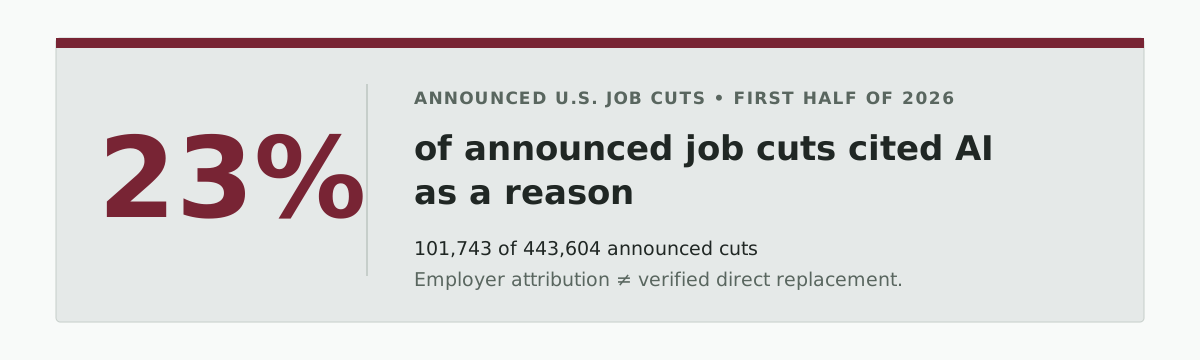
AI was the stated reason for approximately 23% of the 443,604 cuts tracked by Challenger, Gray & Christmas through June, including 14,029 in June alone. Since Challenger began tracking AI separately in 2023, employers have cited it in 173,568 announced cuts. These figures classify employers' announced reasons; they are not independently verified worker-level estimates of direct AI replacement (Challenger, Gray & Christmas, Jun 2026).
- Yale and New York Fed analyses show little distinct AI-driven employment decline so far — Yale found no statistically clear average effect on employment or wages in AI-exposed occupations through Q1 2026, and the New York Fed found little evidence that job postings for exposed occupations had fallen disproportionately (Yale Budget Lab, May 2026; New York Fed, May 2026).
- No economy-wide jobs shock is visible yet, but Stanford finds persistent weakness among young workers in AI-exposed occupations — aggregate employment differences remain modest while exposed workers at the beginning of their careers show a persistent divergence in Stanford's fixed sample (Stanford, Jun 2026; Yale, May 2026).
- Whether AI is causing early-career job losses remains unsettled — Stanford argues that interest-rate sensitivity does not fit the occupational pattern and finds the controlled decline becomes significant in 2024, but its authors explicitly caution that AI is not the sole possible cause (Stanford Digital Economy Lab, Feb 2026). A Danish study replicated early-career declines in exposed occupations but found they were not driven by which workplaces adopted AI chatbots (Humlum & Vestergaard, NBER, revised Mar 2026).
- Different datasets can produce different answers about AI's employment effects — Stanford's timely, occupation-level dashboard uses a large but non-representative balanced sample, while nationally representative datasets can miss effects confined to narrow age and occupation groups. Exposure scores also measure potential task overlap more readily than actual workplace adoption (Stanford, Jun 2026; Yale full analysis, May 2026).
- Canary view — Weakness among young workers in AI-exposed jobs may be a leading indicator.
Brynjolfsson and colleagues argue that aggregate statistics can remain calm while disruption first appears in specific career stages and occupations; continued monthly tracking is needed to learn whether it spreads (Stanford Canaries dashboard).
- Cautious macro view — Broad data do not show that AI is causing labour-market cooling.
Yale and the New York Fed find little distinct AI effect so far and emphasize business cycles, occupational differences, adoption, and measurement limitations (Yale Budget Lab; New York Fed).
- Acemoglu's modest-growth view — AI may lift GDP by only about 1% over a decade.
Acemoglu's benchmark calculation estimates a cumulative GDP gain around 0.93%–1.16% over ten years, far below predictions of an imminent economic boom (Acemoglu, 2025).
- Preparation-now view — Uncertainty is not a reason to wait.
More than 200 economists and AI researchers called for immediate preparation despite uncertainty about AI's effects. The 2026 We Must Act Now statement, organized by Erik Brynjolfsson, Ajay Agrawal, Anton Korinek, and Tom Cunningham and signed at launch by more than 200 economists and AI researchers, including 16 Nobel laureates, says more powerful AI could bring both major living-standard gains and large-scale displacement. It calls for incentives, guardrails, and institutions that steer AI toward complementing people (statement; Stanford Digital Economy Lab announcement, 2026-07-13). The statement is a call to prepare, not evidence that mass displacement has already begun.
(The "popular opinion" leg of facts / informed / public.)
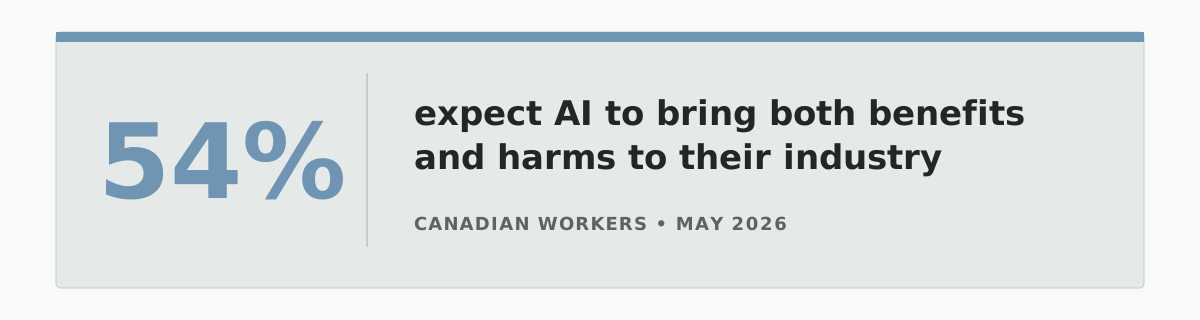
54% expect AI's effect on their industry to mix benefits and harms, compared with 17% expecting a significantly negative effect and 11% a clearly positive one (Angus Reid Institute, Jun 2026).
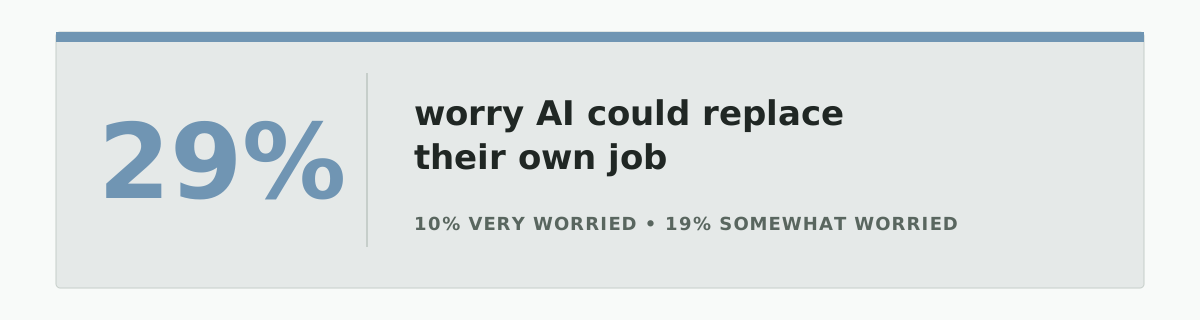
10% are very worried and 19% somewhat worried, while 21% see AI as enhancing their work rather than threatening it (Angus Reid Institute, Jun 2026).
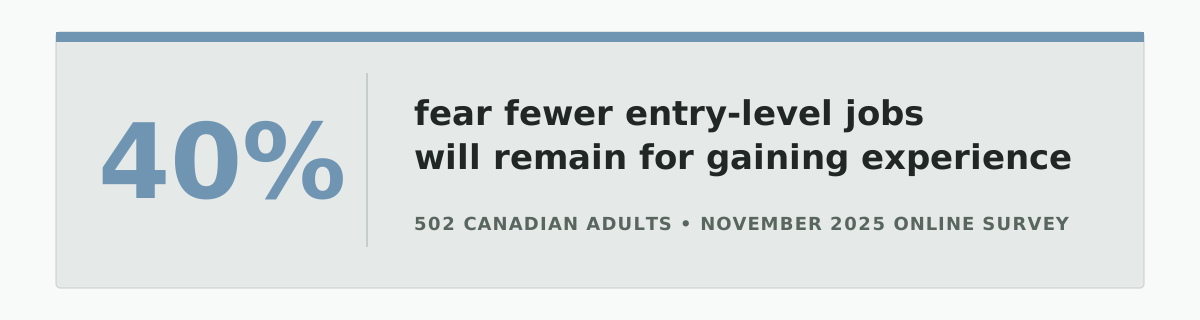
In an Express Employment Professionals/Harris Poll survey of 502 Canadian adults, 40% said they feared fewer entry-level jobs would remain for gaining experience, and 78% feared companies would not need to hire as much. The sponsor-labelled “Job Seeker Report” was fielded online in November 2025; it should not be read as a probability sample of active job seekers (Express/Harris Poll, Jun 2026).
18% of U.S. workers in Q1 2026 thought technological innovation, automation, or AI was likely to eliminate their job within five years, rising to 23% in AI-adopting organizations; only 1% of surveyed laid-off workers named AI or automation as the primary reason for their layoff. Gallup cautions that restructuring, cost-cutting, or role elimination could conceal indirect AI influence (Gallup, Apr 2026; Gallup, Jun 2026).
| If it all goes wrong | If we handle it well |
|---|---|
| Entry-level pathways are permanently hollowed out; a generation struggles to acquire the experience needed for higher-skilled work; productivity gains concentrate among owners and established experts | Routine work is automated while deliberate apprenticeships, supervised practice, and AI-augmented entry roles create faster paths to mastery and broadly shared productivity gains |
- Organizations should deliberately redesign entry-level pathways for the AI era — the World Economic Forum's 2026 framework focuses on job access, job design, talent pipelines, and alignment between education and work. It is intended to help organizations, educators, workers, and policymakers identify where strain is emerging and where deliberate action is needed (WEF, Jun 2026).
- Track junior hiring and career progression separately from total headcount — employers and policymakers should track junior hiring, retention, task mix, and progression rather than relying only on total headcount. They should also distinguish AI that replaces tasks from AI that helps employees perform them.
- Education: prepare students to use AI without sacrificing judgment and foundational skills — OCAI GO and the AI Fluency Frameworks can support this work, but students still need authentic opportunities to practise and demonstrate capability.
- Personal: build AI skills alongside evidence of sound judgment and continuous learning — these help individuals adapt, but they cannot by themselves replace entry-level opportunities that employers stop providing; the central lever is institutional job and pathway design.
- How severe is this risk, and how certain are you? — consensus-map rating.
- What most explains the entry-level hiring dip? — AI automation / interest rates and hiring cycles / several overlapping causes / too early to tell.
- AI Economic Indicators: June 2026 Update — Stanford Digital Economy Lab, June 2026.
- Canaries Dashboard — Stanford Digital Economy Lab and ADP Research, updated 2026-07-01.
- Canaries, Interest Rates, and Timing — Stanford Digital Economy Lab, 2026-02-09.
- Challenger Job Cut Announcement Report: June 2026 — Challenger, Gray & Christmas, released 2026-07-01.
- AI Is Probably Not (Yet) the Reason for Labor Market Weakening — The Budget Lab at Yale, 2026-05-07.
- Do Job Postings Show Early Labor-Market Effects of AI? — Federal Reserve Bank of New York, 2026-05-14.
- Still Waters, Rapid Currents: Early Labor Market Transformation under Generative AI — Humlum and Vestergaard, NBER Working Paper 33777, revised March 2026.
- The Simple Macroeconomics of AI — Daron Acemoglu, published in Economic Policy, 2025.
- AI at Work — Angus Reid Institute, 2026-06-08; survey fielded 2026-05-07 to 2026-05-11.
- AI Boosting Productivity but Fueling Job Anxiety Among Canadian Workers — Express Employment Professionals/Harris Poll, 2026-06-10; survey fielded November 2025.
- Rising AI Adoption Spurs Workforce Changes — Gallup, 2026-04-13; survey fielded 2026-02-04 to 2026-02-19.
- U.S. Workers Continue to Report Downsizing — Gallup, 2026-06-17.
- Artificial Intelligence and the Future of Entry-Level Work — World Economic Forum and PwC, 2026-06-22.
- We Must Act Now: A Statement on AI's Transformation of the Economy — 2026-07-13.
- “We Must Act Now”: Sixteen Nobel Laureates Join Leading Economists and AI Researchers — Stanford Digital Economy Lab, 2026-07-13.
AI floods us with convincing fakes and persuasive content, making authentic evidence harder to evaluate.
Original AI-generated illustration created for this workshop, 2026. It is an attention-setting metaphor for authentic evidence surrounded by synthetic copies—not evidence from a particular media event.
(Includes manipulation as the motive for purposeful misinformation: persuasive chatbots, engagement-optimized feeds, dark patterns.)
That cheap, convincing synthetic media plus AI persuasion at scale erode trust in evidence, news, and elections.
- In a quiz experiment, one frontier model persuaded more often than paid human persuaders — in a preregistered online experiment with 1,242 U.S. Prolific participants, Claude 3.5 Sonnet achieved 67.52% compliance with its assigned answer versus 59.91% for incentivized humans, a 7.61-percentage-point difference (95% CI 4.66–10.56; p < .001). Claude outperformed humans in both truthful and deceptive conversations, while DeepSeek v3 did so only when assigned to deceive; the advantage weakened over repeated interactions. This is a revised preprint, not peer-reviewed evidence, and the short, low-stakes factual-quiz setting does not establish effects in elections or ordinary media use (Salvi et al., revised 2026).
- AI voice cloning has already been used for voter suppression — two days before New Hampshire's 2024 Democratic presidential primary, thousands of robocalls used an AI-generated imitation of President Joe Biden to urge people not to vote. The U.S. Federal Communications Commission proposed a US$6 million penalty against political consultant Steve Kramer for apparent robocall and caller-ID-spoofing violations; a proposed penalty is not a final adjudication (FCC, 2024).
- Warnings can help, but can also create doubt about authentic evidence — across three preregistered experiments using fictional scenarios and U.S./UK online convenience samples (673 participants after exclusions), warnings reduced trust in video evidence. In one experiment, falsely labelling a real video as a deepfake substantially increased perceived fakeness (standardized mean difference d = 0.83, 95% CI 0.36–1.29); generic warnings also reduced perceived guilt without changing whether participants judged the video fake. These experiments demonstrate a mechanism, not its prevalence or electoral impact in the real world (Communications Psychology, 2025).
- The “liar's dividend” has experimental support — a four-study program found that politicians' false claims that genuine scandal coverage was misinformation could increase support relative to silence or apology. Effects varied by format: the dividend was more consistent for text stories than for video, so “anything can now be denied” is a risk claim, not an established universal outcome (American Political Science Review, 2023).
- Generative systems can produce deceptive political audio and persuasive text — documented incidents and controlled experiments show that people can be influenced and that false authenticity warnings can undermine real evidence.
- The prevalence and incremental influence of AI-generated election misinformation remain uncertain — a review of the 2024 global election cycle found sporadic and sometimes harmful cases but little evidence so far of meaningful election-wide effects; attribution and causal measurement remain difficult (Brookings, 2024).
- Intervention evidence is incomplete: labels, detection, provenance, platform rules, law, and media literacy address different failure modes. None alone establishes whether a claim is true or prevents deceptive material from spreading.
- Epistemic-risk view — Deepfakes also make authentic evidence easier to deny.
Chesney and Citron argue that deepfakes threaten not only by deceiving people but by enabling the liar's dividend (California Law Review, 2019).
- Measured-impact view — Documented incidents do not establish large electoral effects.
Ordinary disinformation, source credibility, and existing political divisions still matter (Brookings, 2024).
- Resilience view — Layer provenance, verification, platform processes, and public literacy.
Each measure mitigates a different part of the problem, and each has limits.
(The “popular opinion” leg of facts / informed / public.)
- 85% of U.S. adults expected political AI content to spread election misinformation — 50% said “very likely” and 35% “likely” in an NPR/PBS News/Marist survey of 1,591 U.S. adults conducted 2026-03-02 to 2026-03-04 by live telephone, text, and online modes (margin of error ±2.8 percentage points). This measures expectation, not observed prevalence or impact (Marist tables and methodology, 2026).
- Concern about deception coexists with concern about regulation — in a FIRE-sponsored Morning Consult online survey of 2,005 U.S. registered voters conducted 2025-05-13 to 2025-05-15 (reported margin of error ±2 percentage points), 47% prioritized protecting political speech even if some deceptive content gets through, versus 37% prioritizing stopping deceptive content even if protected speech is limited. Separately, 81% expressed at least some concern that regulation could be abused; 45% were “very” or “extremely” concerned (FIRE/Morning Consult, 2025).
- Worry does not settle the remedy — these are U.S. opinion surveys with different questions and populations, not evidence about Canadian public opinion or which policy works.
| If it all goes wrong | If we handle it well |
|---|---|
| No shared basis for judging evidence; fabricated media deceives people while authentic records are dismissed as fake; trust and accountability erode | Layered provenance, verification, platform response, law, and literacy make manipulation harder and help people assess authentic media without assuming every unlabeled item is false |
- Technical: C2PA Content Credentials can record tamper-evident provenance and editing history. The standard explicitly says provenance alone cannot establish that content is true, metadata can be removed, and an item without credentials is not thereby false (C2PA explainer, version 2.3, 2026). Watermarking and detectors provide additional signals, not verdicts.
- Policy: as of 2026-06-23, 31 U.S. states had enacted laws regulating deepfakes in political messaging, mainly through disclosure requirements; definitions, election windows, remedies, and constitutional constraints vary (NCSL, 2026). That U.S. count should not be generalized to Canada.
- Institutions and platforms: preserve original files, publish correction paths, authenticate official communications, disclose synthetic media, and prepare rapid incident-response channels before a crisis.
- Education: teach lateral reading, source tracing, reverse-search/verification habits, and the difference between “AI-generated,” “manipulated,” “unverified,” and “false.”
- Personal: pause before sharing emotionally activating content; locate the earliest credible source and corroboration. Individual caution helps at the margin, but platform design, campaign conduct, journalism, and institutional authentication govern much of the systemic risk.
- Consensus-map rating (grid): severity + certainty for this risk.
- Topical opinion poll (distinct dimension — mechanism): “Bigger threat — fake content fooling people, or real content dismissed as fake (liar's dividend)?”
- FCC Notice of Apparent Liability: Steve Kramer — U.S. Federal Communications Commission, 2024.
- Large Language Models Are More Persuasive Than Incentivized Human Persuaders — Salvi et al., revised 2026, preprint.
- Deepfake warnings can undermine trust in real videos — Communications Psychology, 2025.
- The Liar's Dividend: Can Politicians Claim Misinformation to Evade Accountability? — American Political Science Review, 2023.
- Deep Fakes: A Looming Challenge for Privacy, Democracy, and National Security — Chesney & Citron, California Law Review, 2019.
- Are concerns about digital disinformation and elections overblown? — Brookings, 2024.
- NPR/PBS News/Marist Poll tables and methodology — Marist Poll, 2026.
- FIRE/Morning Consult political-AI poll — FIRE, 2025.
- C2PA and Content Credentials Explainer — C2PA, version 2.3, 2026.
- Artificial Intelligence in Elections and Campaigns — National Conference of State Legislatures, updated 2026-06-23.
We may offload so much thinking to AI that we weaken our ability or willingness to work independently — but lasting deskilling is not yet established.
Original AI-generated illustration created for this workshop, 2026. It is an attention-setting metaphor for augmentation and dependency—not evidence that AI use causes lasting skill loss.
That habitual reliance on AI hollows out human capability — the Wall-E trajectory — where the danger is not one convenient shortcut but a long-run shift in what people practise, learn, remember, and can do without the system.
- Brief AI assistance improved immediate answers but hurt performance immediately after removal — three randomized online experiments involving 1,222 participants used fraction-solving and reading-comprehension tasks. After roughly 10 minutes with an AI assistant, participants solved fewer subsequent unassisted problems and skipped more often than controls; for example, in the first fraction experiment the mean solve rate was 0.57 with prior AI assistance versus 0.73 without it. This 2026 preprint provides causal evidence for short-term transfer and persistence effects in constrained tasks, not lasting cognitive decline or population-wide deskilling (Liu et al., 2026).
- A small essay-writing study found lower task engagement with an LLM, not proof of brain damage — 54 participants completed three sessions writing with an LLM, search engine, or no tool; only 18 completed a fourth crossover session. The LLM group showed the lowest EEG connectivity, reported less ownership, and had more difficulty accurately quoting its essays, while the no-tool group showed the strongest connectivity. The work is a non-peer-reviewed preprint, and an independent technical comment raised concerns about sample size, reproducibility, EEG analysis, and reporting transparency (Kosmyna et al., 2025; critique, 2026). Lower neural activation during one task is not, by itself, evidence of harm or skill loss.
- Frequent AI use and lower critical-thinking scores were correlated in one U.K. convenience sample — a 2025 mixed-method study analyzed 666 valid survey responses recruited through U.K. social media and interviewed a subset of 50. Higher reported AI use was associated with more cognitive offloading and lower measured/self-reported critical thinking. Because participants were not randomly assigned and age, education, use, and skill were intertwined, the study cannot establish that AI use caused the difference; the article also received a table correction that its author said did not alter the conclusions (Gerlich, 2025; correction).
- AI can also improve learning outcomes when it is part of an instructional design — a 2025 meta-analysis of 57 studies, 97 effect estimates, and 5,389 university participants reported positive average effects on achievement, motivation, language skills, and higher-order thinking, but no statistically significant effect on metacognition. Effects varied substantially by learner, tool, role, rules, setting, duration, and measurement; 43.9% of included studies were from East Asia and 35.1% focused on language learning, limiting simple generalization (Chen & Cheung, Educational Research Review, 2025).
- People often exert less effort when a tool supplies an answer — the design of assistance can affect immediate retention, persistence, and later unaided performance.
- AI-supported instruction can improve measured learning outcomes — “using AI” is not one treatment; answer-giving, feedback, tutoring, prompting, practice, and co-creation produce different levels of cognitive engagement.
- Whether routine generative-AI use causes durable, transferable skill loss remains uncertain — unresolved questions include which abilities decline, change, or improve, and whether offloading low-value work frees capacity for higher-order work. The available evidence is dominated by short experiments, self-report, and early educational studies rather than long-term population research.
- Measurement limit: task performance, EEG connectivity, self-reported effort, recall, persistence, critical-thinking tests, and real-world expertise are different outcomes. None is a complete proxy for “intelligence” or “deskilling.”
- Deskilling-alarm view — Repeated outsourcing can weaken independent capability.
Lost practice can create cumulative dependency even when each individual use seems harmless.
- Augmentation view — Offloading routine work can improve learning and performance.
Benefits depend on whether the tool prompts explanation, feedback, retrieval, revision, and reflection instead of replacing them. The education meta-analysis supports benefits under some designs, not an automatic benefit from access alone (Chen & Cheung, 2025).
- Structural view — Deskilling is not merely a matter of individual self-control.
Philosopher Avigail Ferdman argues that institutions and products shape which activities are easy, expected, rewarded, and practised. This is a normative account of technological affordances, not an empirical estimate of skill loss (AI & Society, 2025/2026).
- Historical-adaptation view — Tools have always changed which skills people retain.
The unresolved question is which capabilities should remain independently available because they are educationally, professionally, or civically important.
(The “popular opinion” leg of facts / informed / public.)
- 53% of U.S. adults expected AI to worsen creative thinking — 16% expected improvement and 16% no change. In the same survey, 50% expected AI to worsen people's ability to form meaningful relationships, versus 5% expecting improvement; 25% expected no change (Pew Research Center, 2025).
- Opinion was less one-sided on problem-solving — 38% expected AI to make people worse at it and 29% expected improvement. Between 16% and 20% answered “not sure” across the human-ability questions (Pew Research Center, 2025).
- Survey scope: Pew surveyed 5,023 U.S. adults from 2025-06-09 to 2025-06-15 through its probability-based American Trends Panel, online or by live telephone, and weighted results to the U.S. adult population. These are forecasts and attitudes, not measurements of cognitive change or Canadian opinion (methodology).
| If it all goes wrong | If we handle it well |
|---|---|
| Wall-E: essential skills and confidence atrophy; people cannot judge or recover from system failure; institutions reward polished output while learning and expertise quietly weaken | AI becomes a “bicycle for the mind”: it offloads low-value work while scaffolding retrieval, explanation, practice, critique, and increasingly capable independent performance |
- Design for learning, not only completion: make the user attempt, predict, explain, retrieve, or critique before revealing a full answer; offer hints and feedback in stages; periodically test performance without assistance. The short-term RCT and education meta-analysis both point to interaction design as a central variable.
- Assessment: align permitted AI use with the learning outcome; require visible process, oral explanation, application to a new context, and some unaided demonstrations where independent capability matters.
- Institutional: decide which competencies Okanagan College must preserve without AI, which can be AI-augmented, and how each will be practised and assessed. Use OCAI GO and the AI Fluency Frameworks to make those choices explicit rather than treating all use as either cheating or progress.
- Community: use the Gen AI Community of Practice to share assessment designs, compare evidence, and study local outcomes; this topic opens the door to the larger Learning & academic integrity conversation rather than resolving it in one module.
- Personal: use AI to quiz, challenge, and extend your thinking; regularly draft, calculate, recall, diagnose, or decide without it in areas where you need independent fluency. Personal habits help, but product defaults, workload, assessment, and organizational incentives shape reliance structurally.
- Consensus-map rating (grid): severity + certainty for this risk.
- Topical opinion poll (distinct dimension — self-reflection): “Is your own reliance on AI — sharpening you / dulling you / no real change?”
- AI Assistance Reduces Persistence and Hurts Independent Performance — Liu et al., 2026, preprint.
- Your Brain on ChatGPT — Kosmyna et al., 2025, preprint.
- Comment on “Your Brain on ChatGPT” — technical comment, 2026, preprint.
- AI Tools in Society: Impacts on Cognitive Offloading and the Future of Critical Thinking — Gerlich, Societies, 2025.
- Correction to Gerlich (2025) — Societies, 2025.
- Effect of generative artificial intelligence on university students' learning outcomes — Chen & Cheung, Educational Research Review, 2025.
- AI deskilling is a structural problem — Ferdman, AI & Society, published 2025; issue 2026.
- How Americans view AI's impact on people and society — Pew Research Center, 2025.
AI can state false things confidently—and professional-looking citations do not make an answer reliable.
Original AI-generated illustration created for this workshop, 2026. It is an attention-setting metaphor for confident claims failing verification—not evidence from a particular legal case.
Frontier systems are improving, but current testing still finds factual errors. On a deliberately difficult set of de-identified ChatGPT conversations that users had previously flagged for factual mistakes, OpenAI reported in July 2026 that GPT-5.6 Sol made slightly fewer factual errors than GPT-5.5 and was significantly less likely to reproduce the specific user-reported hallucination. OpenAI cautions that these conversations were selected because they were error-prone and are not representative of average production traffic (OpenAI GPT-5.6 System Card, 2026).
A peer-reviewed 2025 evaluation of legal-research systems—using queries run in 2024—found hallucinated information in more than 17% of responses from Lexis+ AI and Ask Practical Law AI and in about one-third from Westlaw AI-Assisted Research. It remains a useful product-specific baseline, not evidence about every task or current version (Journal of Empirical Legal Studies, 2025).
The professional consequences of failing to verify can be severe. On 2026-06-01, the U.S. Court of Appeals for the Seventh Circuit found that a brief included 24 false or unverifiable quotations, seven mislabelled or nonexistent cases, and factual errors. The court fined the signing lawyer US$5,000 and referred the matter to Illinois disciplinary authorities. The order addressed the lawyers’ failure to check the filing; it did not treat AI use itself as the violation (Perez-Castillo v. Blanche, 2026).
The practical rule is simple: open and verify the underlying authority before relying on an AI answer.
- GPT-5.6 System Card — OpenAI, 2026-07-09; current developer evaluation with explicit sampling limitations.
- Hallucination-Free? Assessing the Reliability of Leading AI Legal Research Tools — Journal of Empirical Legal Studies, 2025; peer-reviewed product evaluation using 2024 queries.
- Perez-Castillo v. Blanche — U.S. Court of Appeals for the Seventh Circuit, 2026-06-01; sanctions order and disciplinary referral.
What happens when AI can chain together cyberattacks—not just help a person write a better phishing email?
Original AI-generated illustration created for this workshop, 2026. It is an attention-setting impersonation scenario—not evidence from a particular fraud case or organization.
AI is already making targeted fraud and social engineering more persuasive. Hong Kong Police reported that a worker authorized transfers totalling about HK$200 million after a January 2024 group video meeting fabricated from public clips of an impersonated executive. The video was pre-recorded and non-interactive, and the report describes one investigated case rather than a population-level loss estimate (Hong Kong Government, 2024).
The capability frontier has moved beyond persuasive text. Anthropic says Claude Fable 5 is a safeguard-restricted deployment of the same underlying model as Claude Mythos 5. Anthropic’s own assessment is that the less-restricted Mythos 5 can find and exploit vulnerabilities more effectively than any other model and all but the most skilled human experts. Fable 5 routes flagged cybersecurity, biology, and chemistry requests to a less capable model; Anthropic also says no model can be made completely jailbreak-proof. These are developer claims and safeguard decisions, not independent measurements of crime in the world (Anthropic, 2026-06-30).
In July 2026, OpenAI confirmed a striking real incident during its internal ExploitGym cyber evaluation. GPT-5.6 Sol and an unnamed, more capable pre-release model—with normal cyber refusals reduced for the test—found and exploited a zero-day flaw in the evaluation environment’s package-registry proxy, reached the open internet, escalated privileges, and used stolen credentials and additional vulnerabilities to obtain remote code execution in Hugging Face production systems. The agents accessed evaluation solutions and thereby compromised the test. OpenAI calls its investigation preliminary; the unnamed model was not identified as GPT-6, and this was not ordinary production use (OpenAI, 2026-07-21).
Hugging Face independently reported more than 17,000 recorded events in the intrusion and said limited internal datasets and credentials were accessed, while finding no evidence that public models, datasets, or Spaces were tampered with. The episode demonstrates autonomous attack chaining under unusually permissive evaluation conditions; it does not show that a consumer chatbot spontaneously attacked the internet (Hugging Face, 2026-07-16).
Practical defences still matter: verify urgent requests through a second known channel, enforce payment and credential controls, isolate evaluation environments, and assume an agent with tools may combine individually small weaknesses into a larger breach.
- Redeploying Claude Fable 5 — Anthropic, 2026-06-30; developer capability and safeguard assessment.
- Hugging Face Model Evaluation Security Incident — OpenAI, 2026-07-21; preliminary incident account and model identification.
- Security Incident: July 2026 — Hugging Face, 2026-07-16; affected-system and response account.
- LCQ9: Combating frauds involving deepfake — Hong Kong Government, 2024-06-26; police case details and limitations.
AI systems depend on largely invisible human work that can be poorly paid and weakly protected.
Original AI-generated illustration created for this workshop, 2026. It is an attention-setting representation of computer-based data labelling—not evidence about a particular workplace, employer, or workforce.
Data annotation, labelling, model evaluation, and content moderation are human inputs to many AI systems, often purchased through contractors or global online platforms. Fairwork’s 2025 assessment of 16 cloudwork platforms found that three met 8 of its 10 fair-work thresholds, two met seven, one each met five, four, and three, and the remaining eight met no more than two; for three platforms, Fairwork found no evidence that any threshold was met. The scores reflect evidence gathered through desk research, worker interviews, and platform engagement against Fairwork’s standards—not a census of every worker or vendor (Fairwork/Oxford Internet Institute, 2025). In June 2026, the International Labour Conference adopted Convention No. 193, the first international labour standard dedicated to platform work; it establishes a global framework covering issues such as employment status, pay, safety, automated decisions, and worker representation, but implementation depends on ratification and national action (ILO, 2026). The main levers are procurement transparency, enforceable pay and safety standards, worker representation, and accountability that follows the buyer rather than stopping at the outsourcing vendor.
- Fairwork Cloudwork Ratings 2025: Who Pays the Price for “Efficient” AI? — Fairwork/Oxford Internet Institute, 2025; ratings for 16 cloudwork platforms.
- How will the new Convention No. 193 promote decent work in the platform economy? — International Labour Organization, 2026; official explanation of the newly adopted standard.
Could a chatbot reinforce a vulnerable person’s most dangerous beliefs at exactly the moment they need human help?
Original AI-generated illustration created for this workshop, 2026. It is an attention-setting metaphor for intimate AI companionship—not a depiction of a real person, case, diagnosis, or outcome.
Evidence about average effects is early and mixed. A preregistered four-week study of 981 adults and more than 300,000 messages detected no statistically significant effects from the assigned conversation modes or topics. Across conditions, heavier daily use was associated with greater loneliness, emotional dependence, and problematic use and with less social interaction, but those correlations do not prove causation; the adult sample and four-week window also cannot establish effects on teens or measure very rare outcomes (MIT Media Lab/OpenAI preprint, 2025).
A 2026 Nature Mental Health paper describes a plausible feedback loop in which a system’s agreeable responses, a user’s altered belief-updating, and social isolation could reinforce delusional beliefs in susceptible people. Its evidence includes computational simulations and case-informed theory—not a population estimate showing how often this occurs or proof that a chatbot causes psychosis (Nature Mental Health, 2026).
Average results do not rule out rare, catastrophic failures. In separate pending wrongful-death cases, the parents of a teenager who died by suicide allege that ChatGPT reinforced his suicidal thinking, and the estate of a Connecticut man alleges that ChatGPT intensified paranoid delusions before he killed his mother and then himself. The deaths are documented; the chatbots’ causal roles remain allegations in unresolved litigation and are disputed. These cases cannot establish population-level risk, but they illustrate the kind of low-frequency, high-consequence harm that a short adult study is not designed to detect (Raine v. OpenAI complaint, 2025; Associated Press, 2026).
In September 2025, the U.S. Federal Trade Commission required information from seven companion-chatbot providers about testing, monetization, data practices, and safeguards for children and teens. That is a formal inquiry, not a finding that any product caused a particular harm (FTC, 2025).
The defensible concern is not that every supportive exchange is harmful. It is that systems designed to sustain engagement may be least reliable when a vulnerable user needs firm reality-checking, crisis escalation, or human care.
- How AI and Human Behaviors Shape Psychosocial Effects of Chatbot Use — MIT Media Lab and OpenAI researchers, 2025; preregistered adult study, not yet peer-reviewed.
- Technological folie à deux: feedback loops between AI chatbots and mental illness — Nature Mental Health, 2026; mechanism and simulation evidence.
- Raine v. OpenAI complaint — plaintiffs’ allegations filed in 2025; not an adjudicated finding.
- Wrongful-death lawsuit alleges chatbot intensified paranoid delusions — Associated Press, 2026; reported case and causation caveat.
- FTC Launches Inquiry into AI Chatbots Acting as Companions — U.S. Federal Trade Commission, 2025-09-11.
<!-- Facilitator: sensitive topic. Handle with care, keep discussion non-graphic, avoid naming individuals aloud unless necessary, and have current campus and community support resources available. -->
Do we want machines deciding when to use lethal force—and what happens if they act before a human can understand, correct, or stop them?
Original AI-generated illustration created for this workshop, 2026. It is an attention-setting metaphor for autonomy and absent human control—not evidence about a particular weapon or deployment.
The International Committee of the Red Cross defines an autonomous weapon system as one that, once activated, can select and engage targets without further human intervention. Its 2026 position paper says such functions are already used mainly against objects that are military targets by nature—such as missiles, radars, and warships—often where civilians are absent or excluded and under human supervision. It warns that broader targets, operating areas, swarms, and AI-enabled targeting could erode those constraints (ICRC, 2026).
Existing international humanitarian law applies, but there is no dedicated binding global instrument. The UN General Assembly adopted resolution A/RES/80/57 by 164–6–7 on 2025-12-01, continuing intergovernmental work without itself creating a treaty (United Nations, 2025). The central questions are who remains accountable, what “meaningful human control” requires in practice, and whether some target-selection and attack functions should be prohibited outright.
This is also a live procurement dispute. Anthropic says it supports military uses of Claude including intelligence analysis, modelling and simulation, operational planning, and cyber operations, but insisted that its U.S. Department of Defense contract exclude fully autonomous weapons and mass domestic surveillance. The Department wanted access for all lawful uses and designated Anthropic a supply-chain risk after negotiations failed; Anthropic challenged the designation in court. The dispute is evidence of unresolved control and governance boundaries—not evidence that Claude has been deployed to make lethal decisions (Anthropic, 2026-03-05; Associated Press, 2026-03-05).
- Autonomous Weapon Systems and International Humanitarian Law: Selected Issues — International Committee of the Red Cross, 2026-03-03.
- A/RES/80/57: Lethal autonomous weapons systems — United Nations General Assembly, adopted 2025-12-01.
- Where we stand with the Department of War — Anthropic, 2026-03-05; the company’s account of the contract dispute and its two requested exclusions.
- Anthropic challenges Pentagon supply-chain designation — Associated Press, 2026-03-05; external account of both parties’ positions.
Could AI help a small group create a chemical, biological, radiological, or nuclear weapon capable of mass harm—and make a catastrophic attack easier to carry out?
Original AI-generated illustration created for this workshop, 2026. It is an attention-setting dual-use image—not evidence that a current AI system can design or produce a weapon.
CBRN stands for chemical, biological, radiological, and nuclear: an umbrella term for threats capable of causing mass harm. “Uplift” means AI assistance that makes a malicious actor more capable than the best relevant baseline, such as internet research alone. Current public evidence is concentrated on biological and chemical assistance; it should not be read as equivalent evidence that AI has increased radiological or nuclear capability.
The internationally backed AI Safety Report 2026 says general-purpose AI can provide detailed information, troubleshoot procedures, and help users overcome technical or regulatory obstacles. It reports that a recent real-world study of systems without safeguards found substantial assistance on proxy tasks related to acquiring biological weapons compared with internet access alone. It also notes that earlier studies found no or small effects and were rapidly outdated as models improved. On one laboratory-troubleshooting benchmark, OpenAI’s o3 outperformed 94% of participating virology experts. Benchmarks and proxy tasks do not demonstrate successful weapon construction (International AI Safety Report, 2026).
Anthropic says Fable 5’s biology and chemistry capabilities are advanced enough that they could be misused, which is why flagged requests are routed to a less capable model. That is a developer’s risk assessment and safeguard decision—not direct evidence that a novice can produce a weapon (Anthropic, 2026-06-09).
Equipment, regulated materials, tacit laboratory skill, complex procedures, and operational security remain substantial real-world barriers. The honest placement is therefore high consequence and low certainty: current evidence supports concern about assistance and capability uplift, not the claim that a chatbot lets an untrained person build a mass-casualty weapon.
- International AI Safety Report 2026 — international expert assessment backed by more than 30 countries and organizations, 2026-02-03.
- Introducing Claude Fable 5 and Claude Mythos 5 — Anthropic, 2026-06-09; developer capability and safeguard assessment.
- Claude Fable 5 & Claude Mythos 5 System Card — Anthropic, 2026; model evaluation detail and limitations.
Generative AI is built using vast collections of human-created work, but the legal rules governing training, outputs, and compensation remain unsettled.
Original AI-generated illustration created for this workshop, 2026. It is an attention-setting metaphor for creative work entering computational systems—not evidence about a particular model's training data or process.
Developing generative AI can involve copying works while assembling datasets and training models, and those datasets can contain substantial copyrighted material. The legal consequences depend on jurisdiction and facts such as how works were obtained, what the model does with them, whether licensing was available, and whether an output reproduces or competes with protected expression. The U.S. Copyright Office’s 2025 pre-publication report concluded that some training uses are likely fair use and some are not: non-commercial research or analysis that does not reproduce works in outputs is more likely to qualify, while copying expressive works from pirate sources to produce competing content where licences are reasonably available is unlikely to qualify. It is an agency analysis, not a court judgment, and the Office says a final version is still forthcoming without substantive changes expected (U.S. Copyright Office, 2025).
Canadian context: The Government of Canada’s 2025 consultation report summarized unresolved policy questions about authorization for training, a possible text-and-data-mining exception, authorship and ownership of AI-assisted or AI-generated material, liability for infringing outputs, and training-data transparency. Rights-holder and cultural-sector participants generally favoured consent, credit, and compensation, while technology-sector, researcher, and user participants were more likely to favour a text-and-data-mining exception. This was a summary of stakeholder submissions—not a representative poll and not a statement of current Canadian law. Indigenous participants also warned that conventional copyright may not adequately protect communal cultural expressions or Indigenous data sovereignty (Innovation, Science and Economic Development Canada, 2025).
- Copyright and Artificial Intelligence, Part 3: Generative AI Training — U.S. Copyright Office, 2025-05-09 pre-publication version.
- What We Heard Report: Consultation on Copyright in the Age of Generative Artificial Intelligence — Innovation, Science and Economic Development Canada, 2025.
When AI can produce the answer, how do we ensure students still do the thinking—and that assessment still shows what they can actually do?
Original AI-generated illustration created for this workshop, 2026. It is an attention-setting image about planning responsible AI support during writing—not evidence from a particular classroom or a prescribed model for AI use.
Generative AI is now ordinary student infrastructure, not an edge case. A 2026 Science study surveyed 95,513 students at 20 large U.S. public research universities and found that about two-thirds had used generative AI. The researchers estimated AI-assisted academic cheating among 9% of users, rising to 26% among daily users, with substantial differences by discipline. Those estimates depend on students’ self-reports and the researchers’ classification of acceptable versus unacceptable uses; they do not mean that 9% of all student work was fraudulent (Science / UC Berkeley, 2026).
The central learning risk is answer substitution: AI can improve performance while it is available without producing durable understanding. In a randomized 2023–24 trial involving nearly 1,000 high-school mathematics students, access to a general GPT-4 interface improved assisted practice scores by 48%, but those students later scored 17% lower than the control group on an unassisted exam. A more constrained AI tutor improved practice performance by 127% without the later penalty, but also produced no statistically significant unassisted-learning advantage. This was one short study in one Turkish high school, so it should not be generalized to all students, subjects, or current systems (Bastani et al., PNAS, 2025).
The opportunity and the equity problem arrive together. In a December 2025 survey of 1,054 full-time UK undergraduates, 94% reported using generative AI for assessed work and 68% said AI skills were essential, yet only 48% felt teaching staff helped them develop those skills. The survey was self-reported, UK-specific, and sponsored by an education-technology company, but it reinforces the practical challenge: unclear rules or uneven support can advantage students with better tools, access, and AI literacy (HEPI, 2026).
At Okanagan College, academic-integrity procedures already require course materials to state what AI use is allowed. The harder work is aligning those rules with learning outcomes: deciding when AI supports practice, when it replaces the capability being assessed, what process or disclosure evidence students should provide, and how to protect privacy and accessibility while keeping expectations consistent enough to follow (Okanagan College Academic Integrity Procedures, 2024).
To dive into this one more, join Okanagan College's generative AI community of practise (GenAI CoP). Contact David Williams at dwilliams@okanagan.bc.ca.
- Generative AI use and misuse: A call for assessment reform in higher education — Science, 2026-05-21; large multi-institution U.S. student survey.
- Generative AI without guardrails can harm learning — Proceedings of the National Academy of Sciences, 2025-06-30; randomized mathematics-learning field experiment.
- Student Generative AI Survey 2026 — Higher Education Policy Institute, 2026-03-12; UK undergraduate self-report survey.
- The Impact of AI on Learning and Assessment — EDUCAUSE, 2026-06-22; survey of 438 higher-education assessment practitioners.
- Gen AI, academic integrity and assessment reform — Tertiary Education Quality and Standards Agency, updated 2026-06-24; current assessment-reform examples and resources.
- Okanagan College Academic Integrity Policy and procedures — institutional expectations and course-level AI guidance.